React Native vs Flutter: Which Is Best for Your App?
When evaluating React Native vs Flutter for a new mobile application, product teams face an immediate crossroad: building separate native codebases for iOS and Android guarantees high engineering overhead and a doubled maintenance burden, yet committing to a cross-platform tool risks crippling performance bottlenecks down the road.
Picture a product team sitting around a whiteboard trying to greenlight a mobile application. They face an immediate crossroad: building separate native codebases for iOS and Android guarantees high engineering overhead and a doubled maintenance burden, yet committing to a cross-platform tool risks crippling performance bottlenecks down the road. Every founder or product manager confronts this exact tension between launching quickly, preserving capital, and delivering a polished user experience. Choosing the wrong framework creates technical debt that lingers long after the initial release. To untangle this decision, you need to look beyond marketing claims and evaluate how React Native and Flutter function under real-world product demands.
React vs. Flutter: What Are You Actually Comparing?
Before evaluating performance benchmarks or hiring costs, you must clarify the technical landscape. Confusion often arises because the search query frequently couples technologies that serve different primary functions.
React is fundamentally a JavaScript library created by Meta for building user interfaces, primarily centered on web applications. React Native takes that component-based philosophy and applies it to mobile development, allowing engineers to build native mobile applications using JavaScript and TypeScript. Flutter, by contrast, is an open-source UI toolkit created by Google that uses the Dart programming language to compile native code for iOS, Android, desktop, and the web.
When people search for “React vs Flutter,” they are usually comparing React Native and Flutter as cross-platform app development frameworks. Both approaches let you write code once and deploy to multiple platforms, but they achieve this through fundamentally different architectural models. Understanding this distinction prevents costly misalignment during tech stack selection.
Performance, UI, and Developer Experience: The Differences That Matter
Is React Native better than Flutter for mobile app development?
The question of whether React Native holds an advantage over Flutter depends entirely on how your application handles rendering and native device integrations. Neither framework is universally superior; instead, they solve cross-platform engineering challenges through opposing paradigms.
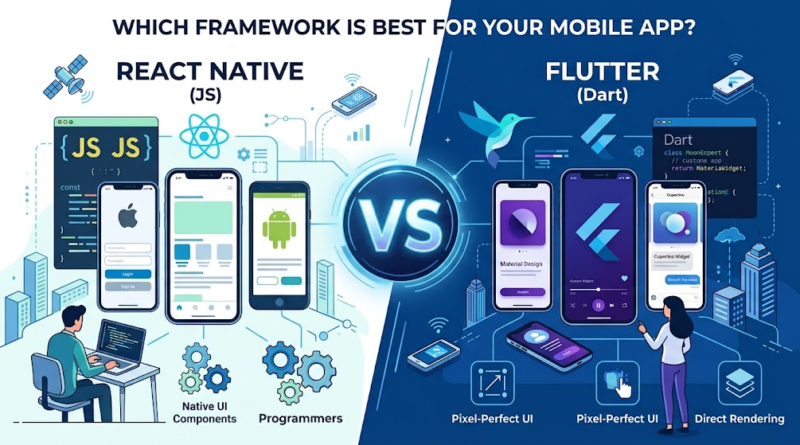
React Native maps your JavaScript components to native platform UI widgets via a rendering bridge or the modern New Architecture (featuring the JavaScript Interface and Fabric renderer). This means a button rendered in React Native is an actual native button on iOS or Android. Consequently, applications built with React Native often blend seamlessly into native operating system design guidelines without heavy manual styling.
Flutter takes a completely different path. Instead of relying on native platform widgets, Flutter paints every pixel on the screen using its high-performance graphics engine (historically Skia, transitioning to Impeller). This guarantees pixel-perfect visual consistency across every device, meaning your app looks and behaves identically whether run on a flagship iPhone or a budget Android handset. However, this approach can make custom native UI patterns require extra work to feel authentically native.
When assessing React Native vs Flutter performance, runtime speed is often debated. Modern React Native architectures have drastically reduced bridge bottlenecks, allowing for smooth 60fps animations. Meanwhile, Flutter compiles directly to machine code via Ahead-Of-Time compilation, delivering exceptional frame rates even for complex, animation-heavy interfaces. For standard CRUD applications, data dashboards, and content-driven feeds, end users cannot perceive any performance difference between the two frameworks.
App Development Cost and Speed: Which Gives You More Value?
Should a startup choose Flutter or React Native for its first app?
For early-stage companies and product teams operating on tight runways, financial efficiency dictates the technology stack. When weighing Flutter vs React Native development cost, software development expenses rarely stem from the framework licenses—both are free and open-source. Instead, total cost of ownership depends on team composition, developer availability, code reuse, and maintenance overhead.
Consider a seed-stage fintech startup aiming to build a cross-platform trading companion. If the founding engineering team has spent years building React-based web products, choosing React Native minimizes onboarding friction. Engineers can pivot between web and mobile features, share business logic, and leverage existing JavaScript libraries. This synergy accelerates time to market and reduces initial engineering expenses.
Conversely, if a team has no legacy web codebase and prioritizes a deeply branded, highly customized user interface from day one, Flutter often proves more cost-effective. Because Flutter includes a rich library of pre-built Material Design and Cupertino widgets, developers spend less time reconciling platform-specific UI bugs.
Long-term maintenance also shapes ownership costs. Cross-platform app development frameworks inherently reduce the effort required to patch bugs across both iOS and Android simultaneously. However, updates to operating systems can occasionally break native modules in React Native or require canvas adjustments in Flutter, making code maintainability heavily reliant on the quality of third-party packages your team adopts.
When React Native Wins—and When Flutter Makes More Sense
Selecting the best framework for mobile app development requires matching technical strengths to specific project requirements.
React Native proves exceptionally strong when:
-
Your engineering team already possesses deep expertise in JavaScript or TypeScript.
-
Your product needs to share state management or business logic with an existing React web application.
-
You want applications to inherit native OS design behaviors automatically without excessive custom styling.
-
You rely on an extensive ecosystem of established third-party npm packages.
Flutter shines brightly when:
-
You are building a greenfield application where pixel-perfect brand consistency across every device is non-negotiable.
-
Your product features heavy animations, custom graphic designs, or interactive data visualizations.
-
Your team is comfortable adopting Dart as a primary language for cross-platform app development frameworks.
-
You plan to scale rapidly across mobile, desktop, and web from a single unified codebase.
Despite their versatility, neither framework is a universal panacea. If your application demands intensive 3D gaming, low-level hardware access, or complex augmented reality processing, native development in Swift and Kotlin remains the superior choice. Similarly, if your core offering is primarily informational, a responsive web application may eliminate the friction of app store distribution entirely.
How to Choose the Right Framework for Your Next App
To crystallize your decision, evaluate your project through a structured lens rather than chasing industry hype. Run your product requirements through this decision checklist:
-
Team Capabilities: Do your engineers have web backgrounds in JavaScript, or are they willing to learn Dart?
-
Target Platforms: Are you targeting mobile exclusively, or do you have immediate plans for desktop and web expansion?
-
UI Complexity: Does the app require standard native form controls, or a highly customized, animation-rich brand experience?
-
Integration Needs: Does the app rely heavily on platform-specific native APIs, Bluetooth peripherals, or background processing?
-
Budget and Timeline: Which stack lets your team ship the MVP fastest without accumulating unsustainable technical debt?
If your startup has existing web developers and wants to share code with a React-based web platform, React Native offers a pragmatic, low-risk path. If you are launching a greenfield consumer application where visual flair and consistent cross-device rendering drive user retention, Flutter provides an exceptional toolkit.
Ultimately, the best framework is not the one with the most GitHub stars or the loudest community advocacy. It is the technology that aligns seamlessly with your product requirements, leverages your team’s core capabilities, and supports your company’s long-term scale.
Ready to Build Your Mobile App?
Choosing the right technology stack is the critical first step toward a successful product launch. Whether you are leaning toward React Native or Flutter, collaborating with an experienced software development partner ensures your architecture scales smoothly from MVP to enterprise growth. Discuss your product requirements, technical constraints, and roadmap with our engineering team today to make an informed, confident decision before development begins.
