
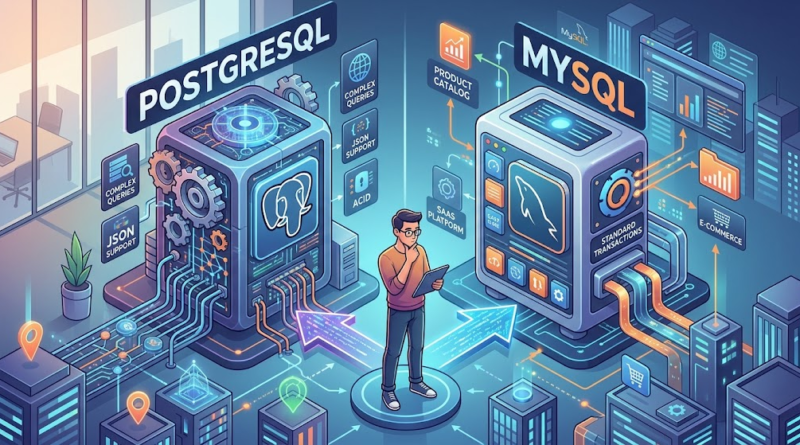
PostgreSQL vs. MySQL: Which Is Best for Your Product?
Imagine launching an early product prototype with a database chosen purely for its quick setup speed. Eighteen months later, your user base has grown tenfold, complex analytical reporting queries are timing out, custom data types are missing, and rewriting your core data layer threatens your entire product roadmap.
Choosing a data store is one of the most consequential architectural decisions a technical team makes. Both PostgreSQL and MySQL are dominant, battle-tested, open-source relational database management systems (RDBMS) powering countless digital products. However, treating them as interchangeable options frequently leads to technical debt, performance bottlenecks, and unexpected migration costs.
Deciding on PostgreSQL vs MySQL involves balancing strict SQL compliance, extensibility, and concurrency handling against ease of deployment, operational familiarity, and out-of-the-box speed. Beneath their shared surface as relational databases lie fundamentally different engineering philosophies that shape how your product scales, stores data, and evolves.
PostgreSQL vs. MySQL: What Actually Sets Them Apart?
At their core, both systems store data in structured tables with rows and columns, enforce relational integrity through foreign keys, and support transactions using ACID properties (Atomicity, Consistency, Isolation, Durability). Yet, their design trajectories have diverged significantly over decades of active development.
Understanding the Core Trade-Offs in PostgreSQL vs MySQL
PostgreSQL was built with an emphasis on extensibility, standards compliance, and handling complex, data-heavy workloads. It operates closer to an object-relational database model, allowing engineers to define custom data types, functions, and operators.
MySQL, by contrast, was engineered for speed, reliability, and ease of deployment, originating as a fast storage engine for web applications. Over time, MySQL evolved into a robust enterprise database, particularly with the widespread adoption of the InnoDB storage engine, which brought full ACID compliance and row-level locking to the platform.
The primary differences span several distinct areas:
-
SQL Standards Compliance: PostgreSQL adheres strictly to SQL standards, supporting advanced features like window functions, common table expressions (CTEs), and complex constraint checking natively. MySQL supports these capabilities as well, though historical design choices occasionally required workarounds that modern versions have progressively eliminated.
-
Extensibility: PostgreSQL allows developers to write custom functions in multiple languages (like PL/pgSQL, Python, or JavaScript) and install powerful extensions like PostGIS for spatial data. MySQL offers plugin architectures but traditionally favors configuration tuning over deep database-level extensibility.
-
Concurrency Handling: PostgreSQL utilizes a mechanism called Multi-Version Concurrency Control (MVCC) paired with a background vacuum process to handle simultaneous reads and writes without locking tables. MySQL’s InnoDB engine handles concurrency exceptionally well through row-level locking and undo logs.
Performance, Scalability, and Reliability: Which Database Wins?
Neither database is universally faster. PostgreSQL vs MySQL performance depends heavily on your specific workload, schema design, indexing strategy, query complexity, hardware configuration, and deployment architecture.
Workload Patterns and Query Complexity
For read-heavy web applications with simple key-value lookups or standard CRUD (Create, Read, Update, Delete) operations, both databases deliver lightning-fast response times. Performance gaps emerge when workloads become more demanding:
-
Complex Analytical Queries and Joins: PostgreSQL frequently outperforms MySQL when executing deep analytical queries, multi-table joins, and complex aggregations. Its query planner excels at optimizing intricate relational queries out of the box.
-
High-Volume Write Operations: MySQL with InnoDB is legendary for handling high-throughput, write-heavy transactional workloads. Its streamlined execution pipeline makes it a favorite for high-frequency transaction processing where raw write speed is paramount.
-
Concurrency and Locking: In transaction-heavy applications with thousands of concurrent users modifying the same data, PostgreSQL requires careful tuning of its vacuum settings to prevent transaction ID wraparound and bloat. MySQL manages row locks efficiently, reducing contention in high-concurrency environments.
Indexing, Replication, and Maintenance
Achieving high availability requires robust indexing and replication strategies. PostgreSQL offers specialized index types, including GIN (Generalized Inverted Index) and GiST (Generalized Search Tree), which make indexing semi-structured data, full-text search, and geometric types exceptionally efficient. MySQL relies primarily on B-tree indexes, supplemented by functional indexes in modern versions.
When evaluating PostgreSQL vs MySQL scalability, both support master-replica replication, read scaling, and sharding architectures. MySQL provides native group replication for multi-master setups, while PostgreSQL relies on robust streaming replication and community-tested extensions like Citus for distributed scaling. Operational maintenance differs as well: MySQL requires minimal ongoing tuning for standard applications, whereas PostgreSQL demands proactive monitoring of table bloat, connection pooling, and vacuum behavior.
Data Models, JSON, and Complex Queries: Where Each Database Excels
Examining PostgreSQL vs MySQL differences in data modeling reveals distinct strengths when building modern applications that blend structured and semi-structured data.
Handling JSON and Semi-Structured Data
Modern applications frequently ingest flexible payloads from APIs, user preferences, or dynamic product attributes. PostgreSQL introduced JSONB (binary JSON), which stores parsed JSON data alongside efficient indexing capabilities. This allows engineers to query, filter, and update nested JSON documents using specialized operators while maintaining relational integrity.
MySQL also provides robust JSON support with native data types and generated columns that can be indexed for fast retrieval. For standard document storage needs within a relational schema, MySQL’s implementation is swift and efficient. However, for deep querying, path manipulation, and transformation of complex hierarchical documents, PostgreSQL offers a more comprehensive toolset.
Relational Modeling and Advanced Querying
Consider an e-commerce platform managing a dynamic product catalog with thousands of unique attributes. In PostgreSQL, you can leverage custom data types, inheritance, check constraints, and JSONB columns to model complex categories without sacrificing relational integrity.
For a reporting dashboard aggregating millions of order records, PostgreSQL’s advanced window functions and recursive common table expressions enable sophisticated reporting directly within the database layer, minimizing application-level processing overhead. MySQL handles standard reporting with ease, but highly intricate recursive queries often require more careful optimization.
PostgreSQL vs. MySQL for Startups, SaaS, and Growing Products
Translating technical specifications into business decisions requires evaluating how each database supports your immediate product goals and long-term trajectory.
-
Early-Stage Startups: Teams searching for the best database for startups often gravitate toward MySQL for its ubiquitous hosting availability and frictionless setup, or PostgreSQL for its long-term flexibility. If your MVP requires rapid iteration with complex data relationships, starting with PostgreSQL prevents costly migrations later.
-
SaaS Platforms: When building PostgreSQL vs MySQL for SaaS products with multi-tenant architectures and evolving data schemas, PostgreSQL’s advanced indexing, JSON support, and schema-level isolation provide significant architectural breathing room.
-
Web Applications and Content Management: For content-heavy websites and conventional applications, PostgreSQL or MySQL for web applications are both exceptional choices. MySQL powers a massive share of the web via the LAMP stack, offering predictable performance and straightforward maintenance.
PostgreSQL vs. MySQL Comparison Matrix
| Evaluation Factor | PostgreSQL | MySQL |
| Complex queries | Exceptional support for advanced SQL, CTEs, and window functions. | Highly capable for standard queries, optimized for fast retrieval. |
| JSON & data modeling | Native JSONB with indexing; supports custom types and domains. | Reliable JSON document storage with generated column indexing. |
| Web application workloads | Excellent for data-heavy or highly relational architectures. | Proven, highly optimized for standard CRUD web applications. |
| Transaction processing | Robust ACID compliance with strict constraint enforcement. | High-throughput ACID compliance via the InnoDB storage engine. |
| Scaling & high availability | Flexible replication; extensions like Citus for horizontal sharding. | Mature replication ecosystem (Group Replication, primary-replica). |
| Ecosystem & tooling | Rich administrative tools (pgAdmin) and enterprise extensions. | Ubiquitous ecosystem (phpMyAdmin, WordPress/LAMP integration). |
| Operational complexity | Requires attentive maintenance (e.g., vacuuming, parameter tuning). | Generally straightforward out-of-the-box configuration and maintenance. |
| Best-fit scenarios | Analytical depth, complex data models, and enterprise SaaS. | High-traffic web apps, CMS platforms, and rapid MVP delivery. |
How to Choose the Right Database Without Overengineering
Knowing how to choose a database for a product prevents analysis paralysis and aligns your technical stack with your business objectives. Run through this decision framework with your engineering team:
-
What are your data relationship and query requirements? If your product relies on complex hierarchical data, advanced aggregations, or strict custom constraints, PostgreSQL is a natural default.
-
How heavily will you depend on semi-structured data? If heavy JSON querying and manipulation are central to your product logic, PostgreSQL’s
JSONBoffers superior ergonomics. -
What is your team’s operational expertise? Operational familiarity matters more than marginal performance gains. If your engineers have deep expertise running production MySQL clusters, that operational safety outweighs theoretical feature advantages.
-
What are your infrastructure and hosting constraints? Review managed database offerings on your cloud provider of choice to ensure seamless backups, scaling, and monitoring.
-
What do your future product roadmap requirements look like? Anticipate scaling milestones over the next two to three years rather than just the immediate MVP release.
Avoid premature optimization. If performance is a genuine concern for a core feature, validate your assumptions with representative queries, realistic test data, and workload-specific benchmarks rather than relying on generalized benchmarks. Both databases support production-grade applications at massive scale when properly designed, deployed, and maintained.
Build Your Product on a Scalable Foundation
Choosing the right database is just the first step in building a resilient, high-performing digital product. Whether you are architecting a new web application from scratch, scaling an existing SaaS platform, or modernizing your backend database infrastructure, having an experienced engineering partner makes all the difference.
At YorruSoftwares, our software development team specializes in designing robust database architectures, building scalable web and mobile applications, and engineering custom digital solutions tailored to your business goals. Speak with our technical experts today to discuss your product architecture and ensure your technology stack is built for sustainable growth.
