
Laravel vs. Node.js: Which Is Best for Startups?
You have a validated product idea, a fixed budget, and an aggressive runway. Your engineering team or technical advisor asks the defining question: should we build our backend on Laravel or Node.js? Choosing the wrong technology stack early on can trigger costly rewrites, slower feature deployment, or unexpected architectural bottlenecks just as your user base begins to grow.
Evaluating Laravel vs. Node.js is not about finding a universally superior programming language or framework. Instead, it is about aligning your technical architecture with your product roadmap, team expertise, business model, and long-term growth strategy. Let us examine how these two prominent technologies stack up across performance, development speed, cost, and scalability.
Laravel vs. Node.js at a Glance: What Sets Them Apart?
To make an informed choice, you must first understand the fundamental architectural differences between the two environments.
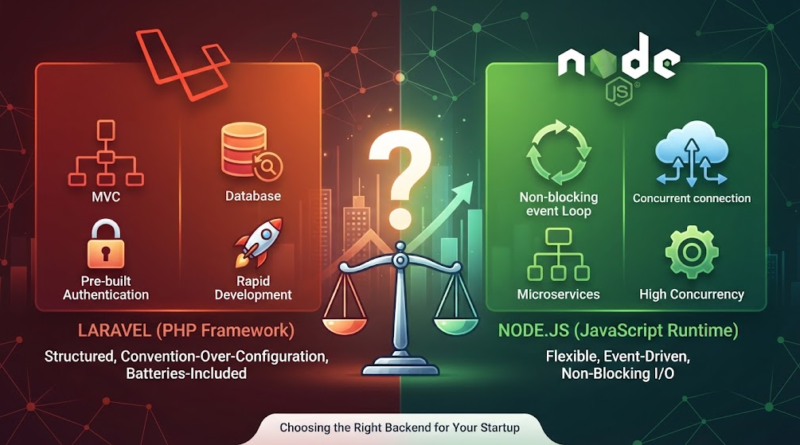
Laravel is a robust, full-stack PHP web application framework known for its expressive syntax and “batteries-included” philosophy. It provides nearly everything a product team needs right out of the box—including authentication, database migrations, an Object-Relational Mapper (Eloquent ORM), robust queue management, and pre-built scaffolding.
Node.js, on the other hand, is a JavaScript runtime built on Chrome’s V8 engine that executes JavaScript outside the browser. It features an event-driven, non-blocking I/O model designed for high-concurrency tasks. Because Node.js is intentionally minimalist, it does not come with a monolithic framework structure. Developers typically pair it with web frameworks like Express or architectural frameworks like NestJS to build application backends.
| Feature / Dimension | Laravel (PHP) | Node.js (JavaScript / TypeScript) |
| Language | PHP (Modern PHP 8+) | JavaScript or TypeScript |
| Development Approach | Batteries-included, opinionated conventions | Modular, flexible, unopinionated core |
| Initial Development Speed | Exceptionally fast for standard CRUD and SaaS features | Fast, provided the team establishes architectural standards early |
| Performance Considerations | Highly optimized with caching; handles standard web requests efficiently | Excellent for asynchronous, I/O-bound operations and high concurrency |
| Scalability | Horizontally scalable using stateless application servers, Redis, and load balancers | Naturally scales via asynchronous event loops and microservices patterns |
| Real-Time Support | Requires tools like Laravel Reverb, Soketi, or WebSockets | Native, highly optimized asynchronous event-driven model |
| Ecosystem & Libraries | Composer package manager; rich ecosystem curated specifically for web apps | npm registry; massive library ecosystem with varying code quality |
| Hiring Considerations | Large global pool of PHP and Laravel developers; rapid onboarding | Massive JavaScript/TypeScript developer talent pool |
| Development & Cost Profile | Lower initial setup cost due to built-in features and conventions | Varies based on framework choice and architectural complexity |
| Typical Use Cases | SaaS platforms, internal tools, e-commerce, content-heavy web apps | Real-time chat, streaming APIs, collaborative tools, microservices |
Performance, Scalability, and Real-World Application Needs
When comparing Laravel vs. Node.js performance, technical decision-makers often rely on synthetic micro-benchmarks that measure raw requests per second in isolated environments. In practice, however, real-world application performance is rarely bottlenecked by the language runtime alone. Database queries, network latency, third-party API response times, and caching strategies dictate overall system speed.
Node.js shines in I/O-intensive, event-driven scenarios. Because its asynchronous runtime handles thousands of simultaneous connections without blocking threads, it is a natural fit for applications that stream data, power real-time collaborative workspaces, or handle instant messaging.
Laravel, traditionally stereotyped as slower due to older PHP versions, has evolved dramatically. Modern PHP (PHP 8.x) delivers exceptional execution speeds. Furthermore, Laravel handles high-performance workloads effortlessly through robust caching mechanisms (such as Redis or Memcached), background job queues, and database indexing. For standard web applications, content portals, and business management software, a well-optimized Laravel backend performs just as quickly as a Node.js equivalent.
When evaluating a Laravel vs. Node.js scalability comparison, consider how each platform grows. Node.js scales naturally in distributed, event-driven microservices architectures. Laravel scales horizontally by separating stateless application servers behind a load balancer, offloading heavy tasks to Redis queues, and utilizing read-replicas for databases. Scaling success depends far more on clean architectural design, proper database indexing, and infrastructure configuration than on the framework choice alone.
Development Speed, Costs, and Developer Availability
For startups, time-to-market is currency. Every week spent writing boilerplate code or wrestling with custom authentication setups consumes precious runway.
Laravel’s opinionated ecosystem acts as a force multiplier for development speed. Features that require piecing together multiple third-party libraries in a Node.js environment—such as database migrations, user authentication, role-based access control, task scheduling, and mail formatting—are built right into Laravel. For a small engineering team building a standard SaaS MVP, Laravel significantly reduces initial development time and engineering overhead.
In contrast, Node.js development speed depends heavily on the chosen framework. A minimalist framework like Express gives developers absolute freedom, but that freedom often leads to inconsistent codebases unless strict team conventions are enforced. Utilizing a structured framework like NestJS bridges this gap by bringing modular architecture to Node.js, though it introduces a steeper initial setup curve.
Regarding Laravel vs. Node.js development cost, budget implications extend beyond initial hourly developer rates. Consider:
-
Initial development time: Framework conventions reduce engineering hours.
-
Onboarding and hiring: Both ecosystems feature massive global talent pools, though JavaScript developers are slightly more ubiquitous due to full-stack web prevalence.
-
Ongoing maintenance: Standardized codebases are easier to audit, refactor, and hand off to new engineers as the team expands.
Consider this scenario: A two-person startup building a standard B2B SaaS platform with customer billing, user permissions, and report generation will typically ship faster and cheaper on Laravel. Conversely, a team building a multi-user real-time whiteboard application will find Node.js more aligned with their technical requirements from day one.
Which Backend Fits Your Startup’s Product and Growth Plans?
Choosing the right technology requires matching your product requirements to the strengths of the framework.
When to Choose Laravel for a Startup
-
SaaS Products with Standard Workflows: Applications requiring structured database models, subscription billing, user management, and transactional emails.
-
Admin Dashboards and Internal Tools: Systems where data organization, CRUD operations, and rapid UI generation are paramount.
-
Content-Driven Platforms and Portals: Customer portals, publishing platforms, and e-commerce stores that rely heavily on relational database integrity.
-
Rapid MVPs: When founders need to validate a product concept quickly without configuring dozens of disparate packages.
When to Use Node.js for a Web Application
-
Real-Time Collaborative Products: Project management tools with live updates, chat applications, and collaborative document editing.
-
I/O-Intensive APIs and Microservices: Systems processing high volumes of concurrent API requests or managing data streams from IoT devices.
-
Unified JavaScript/TypeScript Stacks: Teams seeking to share code, types, and validation logic between frontend frameworks (like React or Vue) and the backend.
-
Asynchronous Event Processing: Applications heavily reliant on webhook listeners and event-driven data ingestion.
Neither technology is a silver bullet. High user traffic alone does not make Node.js mandatory, nor does enterprise growth make Laravel obsolete. Many successful platforms run robust Laravel backends handling millions of requests daily.
| Startup Product Need | Recommended Starting Point | Key Qualification |
| Standard B2B SaaS MVP | Laravel | Excellent for rapid CRUD development and built-in auth. |
| Real-Time Chat / Collaboration | Node.js | Native asynchronous event handling simplifies WebSockets. |
| E-Commerce Platform | Laravel | Rich package ecosystem for payments, catalogs, and orders. |
| Full-Stack JavaScript Team | Node.js | Eliminates context-switching between frontend and backend languages. |
| Data-Heavy Enterprise Portal | Laravel | Strong ORM and relational database management capabilities. |
A Practical Framework for Making Your Final Decision
To finalize your technology decision, evaluate your startup against a structured, repeatable framework:
-
Product Requirements and Workload: Is your application primarily CRUD-driven and relational, or is it event-driven and real-time?
-
Time to Market and MVP Scope: How quickly do you need to launch to test market assumptions?
-
Team Skills and Hiring Availability: What languages and frameworks is your core team already proficient in?
-
Total Cost of Ownership (TCO): Consider not just initial build costs, but long-term maintenance, hosting infrastructure, and future scaling efforts.
-
Future Architectural Needs: Will your product require microservices, third-party integrations, or heavy background processing?
Startup Decision Checklist:
Audit your team’s core engineering strengths before letting external hype dictate your stack.
Focus on shipping your core value proposition rather than optimizing for hypothetical scale on day one.
Ensure clean API boundaries and modular design to maintain future flexibility regardless of your framework.
Avoid choosing a technology purely because it is trending on social media, because a direct competitor uses it, or based on isolated synthetic benchmarks. Switching backend stacks later is expensive, but adhering to sound software engineering principles—such as decoupled architectures, comprehensive automated testing, and solid database design—protects your product against future friction.
Summary Recommendation: If your startup is building a standard SaaS product, e-commerce store, or business application where speed-to-market and structured data management are critical, Laravel is an exceptional choice. If your core product relies on real-time data streaming, high-concurrency event handling, or a unified TypeScript codebase across the entire team, Node.js provides the ideal foundation.
Frequently Asked Questions
Is Laravel or Node.js better for a startup MVP?
Neither is universally better; it depends entirely on your product type. Laravel is generally superior for traditional SaaS MVPs, admin panels, and content platforms because its built-in authentication, database migrations, and scaffolding allow developers to launch core features much faster. Node.js is better if your MVP’s core value proposition depends on real-time data streaming, chat functionality, or high-frequency asynchronous API calls.
Which is more scalable and cost-effective: Laravel or Node.js?
Both technologies can scale to support millions of users when architected correctly, meaning neither holds a monopoly on cost-effectiveness. Laravel often reduces initial development costs for standard business apps due to fewer required third-party packages and faster setup times. Node.js can be highly cost-effective for high-concurrency, I/O-heavy workloads where horizontal server efficiency minimizes cloud resource overhead. Your team’s existing expertise ultimately dictates the most cost-effective choice.
Choosing the right backend architecture is a critical milestone for any growing technology company. If you are preparing to build a new web application, launch a SaaS platform, or modernize an existing system, discussing your product requirements with experienced engineers can save you time, capital, and technical debt. Contact YorruSoftwares to collaborate with our technical team, review your project roadmap, and plan a scalable architecture tailored to your business goals.
