
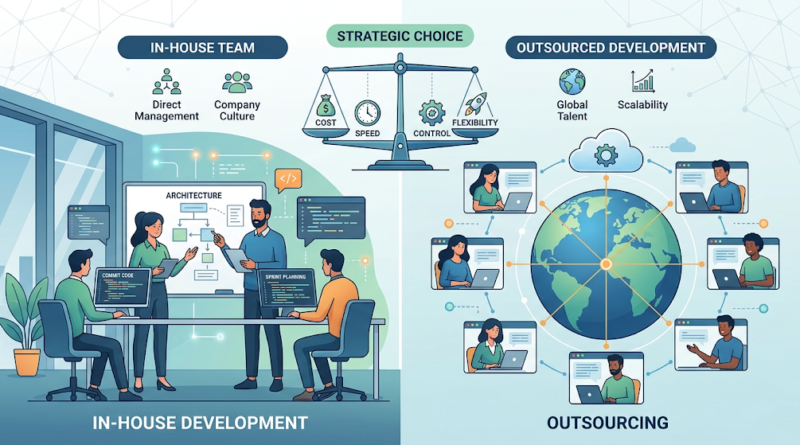
In-House Development vs Outsourcing: Costs, Risks & Benefits
Every software project eventually hits the same critical bottleneck: talent. Whether you are a startup founder racing to launch a minimum viable product (MVP) or a technology leader tasked with modernizing a legacy enterprise system, the decision of who builds your product is just as important as what you are building.
The debate surrounding in-house development vs outsourcing often gets reduced to a simple comparison of hourly rates. However, successful business leaders know the calculation is far more complex. It requires evaluating risk management, operational speed, intellectual property, and long-term product control.
Understanding the differences between building an internal team and partnering with an external vendor can mean the difference between a successful launch and a stalled, over-budget project. Here is a thorough look at the costs, risks, and benefits of both approaches to help you choose the right model.
The Real Cost of Building an In-House Dev Team
When evaluating in-house vs outsourced development costs, companies frequently make the mistake of comparing a developer’s salary directly to an agency’s hourly rate. This approach ignores the significant financial footprint of an internal team.
Building an in-house development team involves substantial direct and hidden costs. The direct costs start with competitive salaries, which have climbed significantly for experienced engineers, architects, and product managers. But the hidden expenses are where budgets truly stretch:
-
Recruitment and Onboarding: Sourcing technical talent takes time and money. Recruitment agency fees often consume 15% to 25% of a developer’s first-year salary. Once hired, it typically takes months for a new developer to understand your codebase and reach peak productivity.
-
Benefits and Overhead: Employer taxes, health insurance, retirement contributions, and paid time off add roughly 25% to 35% on top of a base salary.
-
Infrastructure and Tooling: Providing high-end hardware, cloud environments (AWS, Azure), and enterprise licenses for project management and development tools (Jira, GitHub, IDEs) adds thousands of dollars per employee annually.
-
Management and Retention: Developers require technical leadership. You will need engineering managers or a CTO to guide the team. Furthermore, the tech industry faces high turnover rates. When a senior developer leaves, the cost to replace them—and the resulting delay in your project—can severely impact your bottom line.
Is it cheaper to outsource software development or build an in-house team?
The answer depends entirely on your project duration, team size, and ongoing requirements. For short-to-medium-term projects (under 18 months) or specialized builds, outsourcing is almost always cheaper because you avoid the massive fixed costs of recruitment, benefits, and idle time. You pay only for the work delivered. However, if you are building a massive, proprietary platform that requires years of continuous, heavy iteration by dozens of developers, an in-house team can eventually become more cost-effective as the initial hiring expenses amortize over time.
What You Gain—and Give Up—When You Outsource
Software development outsourcing shifts the burden of hiring, training, and infrastructure to an external partner. This model offers compelling advantages, but it also introduces specific trade-offs that require careful management.
The Benefits of Outsourcing Software Development
-
Faster Project Kickoff: Instead of spending three to six months recruiting, you can typically start development with an outsourced team in a matter of days or weeks.
-
Access to Specialized Talent: If your project requires expertise in machine learning, blockchain, or complex cloud architecture, finding that niche talent locally is difficult. Outsourcing provides immediate access to a global pool of senior specialists.
-
Flexible Team Size: Software development has natural peaks and valleys. You might need three QA testers before launch, but only one for ongoing maintenance. Outsourcing allows you to scale your resources up or down dynamically without firing or hiring internal staff.
-
Reduced Administrative Burden: The vendor handles payroll, HR issues, training, and hardware, freeing your leadership to focus on product strategy and core business operations.
The Trade-Offs and Risks
While the benefits are strong, outsourcing software development is not without risk.
-
Communication Challenges: If you choose an offshore vendor with a significant time zone difference, delayed responses can slow down the feedback loop.
-
Vendor Dependency: Relying heavily on an external team can create dependency. If the vendor’s quality drops or their pricing changes, transitioning away can be challenging.
-
Quality Control: Not all development agencies maintain the same standards. Poor code quality or inadequate testing by a subpar vendor can result in high technical debt.
-
Knowledge Transfer: External developers may not inherently understand your specific industry nuances as deeply as an internal employee would. It requires rigorous documentation and active collaboration to ensure business logic is accurately translated into software.
Control vs. Flexibility in In-House Development vs Outsourcing
Choosing a development approach often comes down to deciding whether you prioritize absolute operational control or adaptive flexibility. Here is a software development team comparison to clarify where each model excels.
Avoid viewing one model as universally superior. An early-stage startup prioritizing speed to market will value the flexibility of an external team, while a bank dealing with highly sensitive financial data may require the strict internal control of an in-house staff.
Speed, Talent & Scalability: The Factors Founders Miss
When analyzing development options, business leaders often focus so intently on budget that they miss the operational factors that actually determine project success: time-to-market, talent availability, and scalability.
Time to Launch In the software industry, speed is a distinct competitive advantage. Imagine a scenario where a startup secures funding and needs an MVP ready in six months. If the founder spends the first three months interviewing developers, setting up payroll, and waiting out notice periods, they have effectively lost half their runway before writing a single line of code. An outsourced team bypasses this delay entirely.
Availability of Specialized Developers Modern software rarely relies on a single technology stack. You might need a React frontend developer, a Node.js backend engineer, a UI/UX designer, and a DevOps specialist. Hiring all these distinct roles internally for a single project is financially impractical. External development companies maintain diverse rosters, allowing you to utilize a designer for a few weeks and a security architect for a few days without carrying their full-time salaries.
Business Growth and Changing Requirements Software projects are rarely linear. As you gather user feedback, your requirements will change. You may realize you need to pivot your mobile app strategy or suddenly integrate an AI recommendation engine. Scaling an internal team to meet sudden pivots is slow and painful. Outsourced models are inherently designed to absorb project complexity and scope changes efficiently.
In-House Development vs Outsourcing: Choosing the Right Model for Your Business
There is no standardized answer for how to build your software. The right choice depends on a candid assessment of your company’s current stage, budget constraints, and technical capabilities.
To determine when to outsource software development versus when to hire, evaluate your project against these criteria:
-
Core Competency: Is the technology itself your primary differentiator?
-
Budget Predictability: Do you need strict control over initial capital expenditure, or can you absorb the high fixed costs of payroll?
-
Speed: Do you need to launch a product or feature next quarter, or do you have a year to slowly build team capacity?
-
Project Duration: Is this a distinct build with a clear launch phase, or an ongoing platform that requires a permanent, dedicated staff of twenty engineers?
When should a company choose in-house development over outsourcing?
Maintaining an internal development capability makes the most sense when the software being built is your company’s core intellectual property and primary value proposition (for example, the core search algorithm at Google). It is also the preferred model when you face strict regulatory, compliance, or security requirements that mandate keeping all data and development environments strictly on-premise, or when you anticipate a permanent need for a large team to execute continuous, daily product iterations.
The Hybrid Approach: The Best of Both Worlds
Many successful companies eventually adopt a hybrid model. This approach involves keeping product ownership, technical architecture, and a small core team of lead engineers in-house. You then partner with an outsourced development company to augment this core team.
In a hybrid setup, your internal leaders maintain strict control over the product vision and code quality, while the outsourced team provides the muscle for heavy coding, quality assurance testing, UI/UX design, or specialized feature development. This provides the security of internal IP ownership alongside the speed and scalability of external talent.
Conclusion
The choice between building an in-house development team and outsourcing software development is a strategic business decision, not just a technical one. In-house teams offer excellent control and deep alignment with company culture, but they require significant capital, time, and management overhead. Outsourcing offers rapid scaling, cost predictability, and immediate access to global talent, but requires strong communication and a trustworthy vendor.
The best model is the one that aligns with your timeline, budget, and long-term business goals.
If you are planning a new software build, modernizing an existing application, or looking to scale your current team, the right structure is crucial. Contact us today to discuss your software project. We can help you assess your technical requirements, estimate project scope, and determine whether a fully outsourced or hybrid team structure will get your product to market faster and more effectively.
