
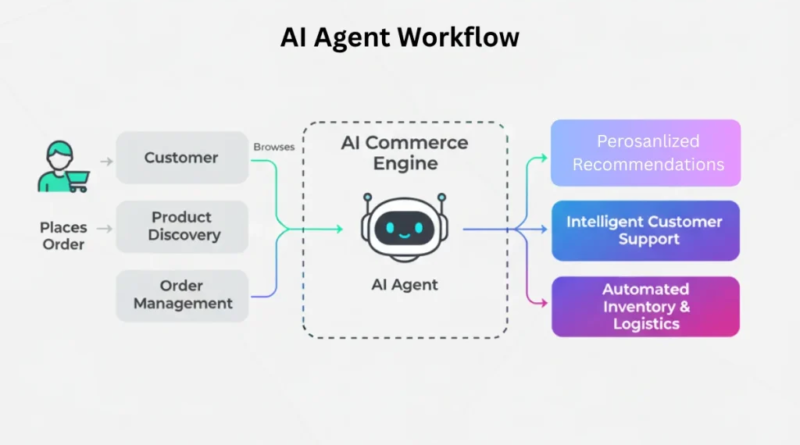
From Apps to AI Agents: What It Means for Your Product
For decades, digital product design has been anchored to a single premise: the user wants to navigate a screen. Whether managing cloud infrastructure or booking corporate travel, software demands that humans click through menus, fill out forms, toggle settings, and orchestrate workflows step by step. We build elaborate dashboards to make this navigation easier, but the underlying paradigm remains unchanged—the user operates the machinery.
Today, that paradigm is shifting. As computing moves toward intelligent systems capable of reasoning and executing multi-step workflows, product leaders face a fundamental question: Are you designing software that helps users navigate features, or are you building systems designed to accomplish outcomes? The emergence of AI agents represents a profound structural evolution in software architecture, user experience, and business strategy. Understanding this transition is essential for any organization building or modernizing digital products.
From Clicking Through Apps to Delegating Tasks to AI Agents
The evolution of software interaction is not simply about changing how a user communicates with a program; it is about shifting the burden of execution. Traditional applications require users to perform the heavy lifting of procedural logic. If you want to reconcile monthly expenses, you open a finance tool, filter transactions, export CSVs, match receipts, and manually input values into accounting ledgers. Every action requires human supervision and direct manipulation.
AI agents fundamentally change this dynamic by operating on intent rather than strictly on procedural input. Instead of forcing a user to click through five screens to execute a multi-step operation, an AI agent can interpret a high-level goal, break it down into sequential steps, query approved tools, and execute parts of a workflow autonomously.
Consider a practical enterprise scenario: invoice processing. In a conventional application, an accounts payable clerk manually reviews incoming invoices, validates line items against purchase orders, flags discrepancies, and routes approvals. With an AI agent integrated into the workflow, the system can independently extract invoice data, cross-reference it against approved purchase records, flag anomalies or pricing variances, and prepare clean items for human sign-off. Crucially, this agent does not operate in a vacuum; it relies on structured data, reliable API integrations, and strictly defined security permissions to ensure accuracy and accountability.
This shift is far more advanced than simply dropping a conversational chatbot onto an existing interface. A standard chatbot answers questions or retrieves static documentation based on a user prompt. An AI agent plans, acts, verifies, and uses software tools to achieve a concrete objective. As these capabilities mature, user expectations will shift from “how do I use this feature?” to “did the system successfully accomplish this task?” However, this transition will be gradual, uneven, and highly dependent on industry requirements and risk tolerances.
What Actually Separates an AI Agent From A Traditional App?
To navigate AI agents vs traditional apps effectively, product teams must move past the marketing buzzwords that currently saturate the tech industry. Not every application that incorporates a large language model qualifies as an agent. The software industry now spans a spectrum ranging from deterministic code to highly autonomous systems.
| Dimension | Traditional Applications | AI-Assisted Applications / Copilots | AI Agents |
| User Interaction | Point-and-click, forms, menus, deterministic UI navigation. | Direct command prompts alongside conventional UI components. | Natural language goal-setting and collaborative delegation. |
| Workflow Execution | Rigid, predefined software logic paths hardcoded by developers. | Assisted generation (e.g., drafting text, suggesting code, summarizing). | Dynamic planning, step selection, and tool execution. |
| System Access | Isolated databases and internal business logic. | Limited context window with restricted API calls or plugins. | Broad, permissioned access to APIs, databases, and external tools. |
| State & Memory | Stateless or session-based transaction logs. | Short-term context within a conversation thread. | Persistent context, historical memory, and iterative task continuity. |
| Autonomy & Control | Zero autonomy; requires manual input for every single action. | Human-in-the-loop review for generated suggestions. | Autonomous multi-step execution under defined guardrails. |
What is the difference between an AI agent and a traditional application?
The primary distinction lies in autonomy and agency. A traditional application executes hardcoded instructions where every branch of logic is anticipated and written by a software engineer. An AI agent uses probabilistic reasoning to dynamically determine the sequence of actions required to achieve a user-defined goal.
Importantly, AI-powered product development does not mean abandoning traditional software engineering. Predefined software logic, robust databases, transactional safeguards, and deterministic API frameworks remain essential. An agent’s power comes from pairing probabilistic intelligence with deterministic software infrastructure, ensuring that while the reasoning is flexible, the execution is secure and reliable.
How AI Agents Could Reshape User Experience and Product Design
As software evolves, AI agents in product design require product managers and UX architects to rethink how digital products are structured. Designing around user outcomes rather than static screens changes every aspect of product planning.
Instead of prioritizing feature discoverability—such as where to place a button in a crowded navigation menu—designers must focus on intent clarity, feedback loops, and trust mechanics. While conversational interfaces will play a major role, they will not entirely replace dashboards, forms, and settings. Conventional interfaces remain vital for edge-case configuration, administrative control, and deep data inspection.
Consider a modern project management or customer relationship management (CRM) product. In a traditional setup, a manager opening their workspace faces dozens of project boards, overdue task notifications, and unread client emails. With an integrated AI agent, the user can provide a high-level prompt: “Review last week’s flagged accounts, summarize the top three blockers, draft personalized follow-up emails for delayed clients, and queue proposed status updates for my review.”
The agent then:
-
Queries the database to retrieve overdue tasks and client notes.
-
Identifies common blockers across teams.
-
Drafts structured follow-up correspondence.
-
Prepares a summary dashboard for executive sign-off.
In this architecture, low-risk actions—such as drafting internal summaries or retrieving analytics—can be executed automatically, while high-risk actions—such as sending external client communications or modifying financial records—require explicit human confirmation. Measuring success in this environment also shifts: product teams must evaluate task completion rates, accuracy, user satisfaction, and time saved rather than relying purely on legacy metrics like daily active users or raw feature clicks.
The Opportunities, Risks, and Trade-Offs Businesses Need to Understand
The transition toward autonomous software offers tremendous commercial advantages, but it also introduces operational risks that product teams cannot afford to ignore.
Where AI Agents May Create Business Value
The business case for AI agent development centers on efficiency, capability expansion, and user enablement. Key areas of value creation include:
-
Eliminating repetitive toil: Automating multi-step administrative workflows across disjointed enterprise tools.
-
Bridging information silos: Connecting unstructured customer feedback, internal wikis, and transactional databases into cohesive insights.
-
Elevating support and retrieval: Moving beyond static knowledge bases to active troubleshooting and guided resolution.
-
Streamlining complex tasks: Helping users navigate intricate regulatory, compliance, or technical workflows with continuous validation.
The Risks Product Teams Cannot Ignore
While the upside is compelling, autonomous software introduces unique failure modes. How AI agents are changing software products also highlights new vulnerabilities:
-
Hallucinations and unreliable outputs: Probabilistic models can misinterpret instructions, invent data points, or fail silently during complex loops.
-
Security and data privacy: Granting external or internal models broad system access creates severe attack vectors, including prompt injection and unauthorized data exfiltration.
-
Operational costs and latency: Multi-step agentic loops require numerous LLM calls, driving up inference expenses and introducing noticeable response delays.
-
Accountability and governance: When a system acts autonomously, determining fault when a mistake occurs becomes a complex legal and operational challenge.
To mitigate these risks, businesses must implement strict architectural guardrails. Systems should adhere to the principle of least-privilege access, ensuring agents only touch necessary data. Furthermore, comprehensive action logging, step evaluations, bounded execution loops, and mandatory human-in-the-loop approvals for consequential actions are non-negotiable foundations for production-grade deployments.
How to Prepare Your Product for the Shift to AI Agents
Successfully navigating this technological shift requires a disciplined, pragmatic engineering strategy rather than a rushed attempt to retrofit generative AI into every corner of your software.
Start With a Real User Problem
Do not build an agent simply because the technology is trending. Begin by auditing your user feedback and product analytics to identify repetitive, multi-step workflows that cause genuine user friction. Validate whether a deterministic script, a simple copilot, or an autonomous workflow is actually required before writing code or selecting an AI model.
Choose the Right Level of Intelligence and Autonomy
Match the complexity of the solution to the severity of the problem. Many workflows benefit more from deterministic automation or simple AI assistance than from fully autonomous agents. Always choose the least complex architectural approach that reliably solves the user’s problem.
Build on Reliable Data and Integrations
The success of any AI agent development for businesses depends almost entirely on data architecture. An impressive AI model will fail in production if it lacks access to clean, structured data, secure APIs, reliable system integrations, and explicit business rules.
How can businesses integrate AI agents into existing software products?
When exploring integrating AI agents into existing applications, businesses can successfully adopt an incremental roadmap rather than rewriting their entire codebase. This involves:
-
Exposing core business logic and database queries through secure, version-controlled internal APIs.
-
Introducing agentic features as modular plugins or specialized sidecars within the existing application shell.
-
Implementing robust middleware layers to handle authorization, state management, and safety guardrails.
-
Gradually expanding agent autonomy as real-world reliability and user trust are proven over time.
Pilot, Measure, and Expand Carefully
Deploy your agentic features to a controlled cohort of users first. Establish clear baselines and track critical operational metrics:
-
Task completion rate and overall accuracy.
-
Human intervention and override frequency.
-
Time saved per completed task and operational cost per transaction.
-
Frequency and severity of unintended actions.
By treating agent integration as an iterative engineering discipline, software product teams can modernize their applications, deliver exceptional value, and future-proof their digital products against rapid technological change.
Ready to Modernize Your Product Strategy?
Navigating the transition from conventional applications to intelligent, agent-driven software requires a balanced approach to product discovery, robust architecture, and secure implementation. Whether you are looking to audit your existing software, design custom AI integrations, or scale an enterprise-grade product, partnering with experienced software engineering experts can ensure your technology roadmap delivers measurable business impact. Contact our team today to discuss your next product evolution.
