
Poor UX Is Costing Your Business More Than You Think
Imagine a highly qualified lead landing on your SaaS pricing page. They have read your case studies, they fit your ideal customer profile, and they have the budget. But when they try to compare tier features, the comparison toggle fails to load properly on their mobile device. They decide to sign up anyway, but the registration form resets after a password validation error, wiping out ten fields of data.
Frustrated, they close the tab and search for your competitor.
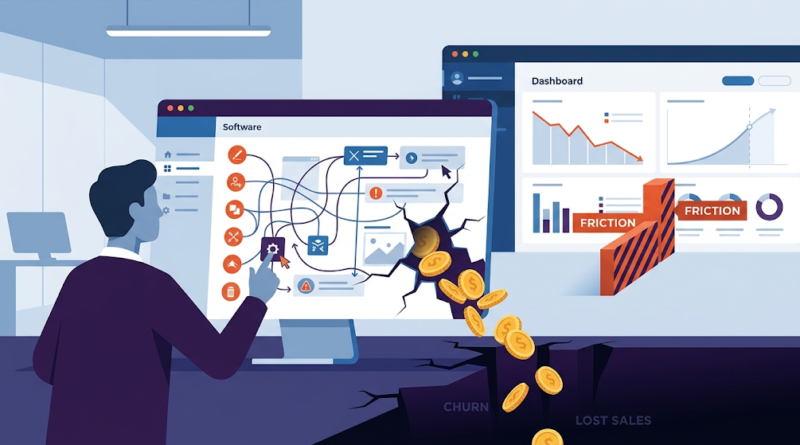
That is not just a software glitch. That is lost revenue. Often, leadership teams view user experience (UX) as a subjective design exercise—an effort to make a product look modern or visually appealing. But aesthetics are only the surface. True UX design is about removing friction. When you neglect how users interact with your software, the hidden cost of poor UX compounds daily through abandoned transactions, churned users, and overwhelmed support teams.
Understanding UX as a core business function is critical. Here is how usability directly influences your bottom line, and what you can do to fix it.
The UX Problems Your Customers Notice Before You Do
To solve UX issues, we first need to distinguish them from UI (User Interface) issues. UI is about how a product looks—the typography, color schemes, and visual hierarchy. UX is about how a product works.
You can have a visually stunning application that still delivers a fundamentally poor UX. Your customers rarely submit support tickets explicitly stating, “Your UX is flawed.” Instead, they exhibit behavioral symptoms that signal deep-rooted friction. These silent revenue killers typically manifest as:
-
Dead-end workflows: Users initiate a process, such as configuring a software integration, but abandon it halfway because the next steps are unclear.
-
Lack of system feedback: A user clicks a “Submit” button and nothing happens for five seconds. Unsure if the system registered the action, they click it three more times, creating duplicate entries or errors.
-
Cognitive overload: Dashboards cluttered with too much data and too few visual priorities force users to hunt for the one metric they actually need.
-
Inconsistent navigation: Features are categorized differently on mobile versus desktop, forcing users to relearn the product depending on the device they are using.
When users encounter these hurdles, they do not blame their own technical skills; they blame your software.
How Poor UX Quietly Drains Revenue and Conversions
The most immediate and measurable consequence of usability friction is its impact on top-line revenue. The correlation between user experience and conversion rates is heavily documented, yet frequently underestimated by product teams prioritizing new feature development over workflow optimization.
Consider a hypothetical B2B SaaS company that generates 10,000 unique website visitors per month. Let’s assume their current trial sign-up conversion rate is 1.5%, yielding 150 new users. If the Customer Lifetime Value (CLTV) is $2,000, that translates to $300,000 in new potential revenue pipeline each month.
Now, suppose a convoluted multi-step onboarding process frustrates users, dropping that conversion rate to 1.0% (100 users).
-
Original pipeline: $300,000 / month
-
New pipeline: $200,000 / month
-
Revenue left on the table: $100,000 / month
In this scenario, a single clunky onboarding flow costs the business $1.2 million annually. The traffic did not change. The product’s core value proposition did not change. The only variable was how difficult it was for the user to hand over their information. This is the direct cost of poor user experience. Every extra field, confusing error message, and slow-loading page acts as a tollbooth on the way to revenue.
The Hidden Costs Beyond Lost Sales
While lost conversions are painful, they are at least visible in your analytics dashboard. The more insidious financial drains are the indirect costs that bleed operational budgets over time.
Spiking Customer Support Overhead
When intuitive design fails, human intervention must take its place. If a user cannot figure out how to reset a password, export a report, or invite a team member, they will submit a support ticket.
Every ticket carries a financial cost—factoring in the hourly rate of your support staff and the software tools used to manage those requests. If poor UX generates 500 avoidable support tickets a month at an average resolution cost of $15 per ticket, you are spending $90,000 a year compensating for bad design.
Customer Churn and Reduced Product Adoption
Getting a user to sign up is only half the battle. If a SaaS application requires hours of training to perform basic functions, user adoption will stall. Frustrated users will simply revert to their legacy systems or spreadsheets. Eventually, the decision-maker auditing the software budget will notice the low utilization rate and cancel the contract.
Exponential Software Development Costs
The later a usability problem is discovered, the more expensive it is to fix. Identifying a flawed user journey during the initial UX design and prototyping phase costs very little—it requires adjusting a wireframe. Discovering that same flaw after the product has been fully coded, QA-tested, and deployed requires tearing down architecture, rewriting code, and issuing new releases.
Employee Inefficiency
If you are building custom internal software—like a proprietary CRM or inventory management system—the hidden cost of poor UX is paid in payroll. If a clunky interface forces 200 employees to spend an extra 15 minutes a day wrestling with the software, that equates to 50 hours of lost productivity daily. Over a year, that is thousands of hours of wasted payroll stemming entirely from bad usability.
What Great UX Does for Retention, Trust, and Growth
Flipping the perspective reveals how investing in usability acts as a growth lever. Leveraging UX design for business growth requires treating the user’s time as a highly valuable asset.
When software is intuitive, the time-to-value (TTV) shrinks. Users experience the core benefit of your product faster, which naturally boosts adoption rates. High adoption integrates your product deeply into their daily workflows, making churn highly unlikely.
Furthermore, exceptional UX builds brand trust. In B2B environments where buyers are making high-stakes purchasing decisions, the quality of your digital interface is often perceived as a proxy for the quality of your company. A seamless, professional, and accessible platform signals competence and reliability. Ultimately, the UX impact on business is profound: in crowded markets where competitors offer identical features, the product that is easiest to use inevitably wins the market share.
A Practical Framework for Calculating Your UX Cost
To secure buy-in for product improvements, business leaders need to quantify the problem. Here is a practical framework to estimate the financial impact of usability friction in your organization.
1. Calculate the Conversion Leak
Identify a critical user journey (e.g., demo requests, checkout, or account creation).
-
Formula: (Total Traffic × Drop-off Rate at the friction point) × Average Deal Size
-
Example: 5,000 visitors start a checkout. 40% abandon it at the payment screen due to a confusing interface (2,000 lost users). If your average deal is $50, the conversion leak is costing you $100,000 per month.
2. Calculate the Support Tax
Audit your helpdesk software and tag tickets related to usability (e.g., “how do I…”, “where is…”, “I can’t find…”).
-
Formula: (Number of usability tickets per month) × (Average cost to resolve one ticket)
-
Example: 300 usability tickets × $20 resolution cost = $6,000 per month spent subsidizing poor design.
3. Calculate Internal Productivity Drag (For Internal Tools)
Estimate the time wasted on clunky proprietary software.
-
Formula: (Hours wasted per employee per week) × (Average hourly wage) × (Number of employees)
-
Example: 2 hours wasted × $30/hour × 100 employees = $6,000 per week ($312,000 annually) lost to poor internal tooling.
By running these basic calculations, you transform subjective design debates into objective financial priorities.
How the Right Technology Partner Mitigates UX Risk
Fixing these issues requires more than a fresh coat of paint. A professional software development partner can help you integrate UX research and usability analysis directly into the product lifecycle.
Rather than blindly writing code, an experienced technology partner will map user flows, build interactive prototypes, and validate product ideas with real users before expensive engineering begins. Once the product is live, they use analytics and user feedback to identify remaining friction points, continuously redesigning web or mobile experiences to improve customer experience and drive business goals.
Frequently Asked Questions
How does poor UX affect a business? Poor UX damages a business by increasing user drop-off rates, reducing software adoption, and increasing customer churn. It also inflates operational costs by generating high volumes of preventable customer support tickets and forcing expensive code rewrites to fix usability issues late in the development cycle.
What is the cost of a bad user experience? The cost includes both direct revenue loss—such as abandoned shopping carts and lost SaaS subscriptions—and indirect costs. Indirect costs encompass damaged brand reputation, lost employee productivity when internal tools are difficult to use, and the wasted engineering hours spent patching avoidable design flaws.
Stop Letting Friction Dictate Your Revenue
UX is not a design metric; it is a business metric. Every confusing menu, slow-loading dashboard, and broken form is actively degrading your conversions, retention rates, and operational efficiency.
The most practical next step is to audit your existing digital touchpoints. Walk through your own product’s onboarding flow, trial sign-up, or daily use cases. Identify the areas that require too many clicks or cause confusion, and run those friction points through the cost framework above.
If your current software is creating bottlenecks, or if you are preparing to build a new digital product and want to ensure it succeeds, it is time to bring in the experts. Reach out to our software development team today to discuss how our UX research, product design, and engineering services can help you build intuitive, high-converting digital experiences that drive real business growth.
