
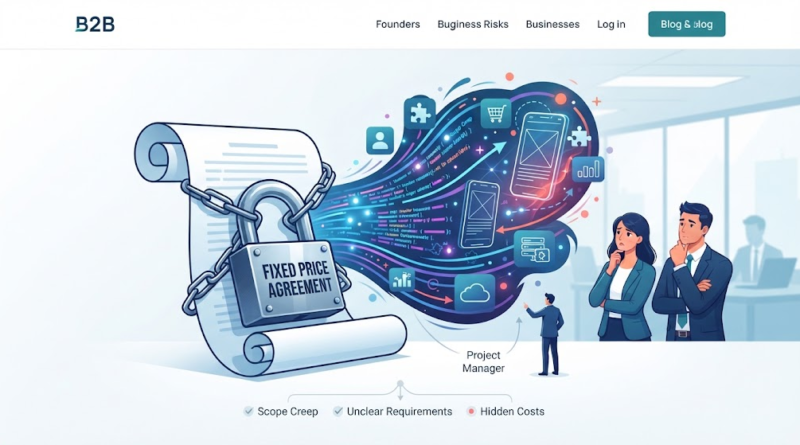
Fixed-Price Software Development Risks: What to Know Before You Sign
Navigating fixed-price software development risks is one of the most critical challenges founders face when building a digital product. A fixed-price quote often feels like a safety net: you hand over your requirements, receive a neat and predictable number, and assume your budget is locked down. No runaway hourly billing, no surprise invoices, and zero awkward conversations about cost overruns.
Unfortunately, software development rarely behaves like a fixed-cost construction project. Code is fluid, requirements evolve as founders gain market feedback, and hidden technical complexities rarely reveal themselves on day one. When an agency locks in a rigid price tag before every detail is understood, someone has to absorb that risk—and it is rarely the agency.
Understanding how fixed-price software development works under the hood is critical for founders and product leaders who want to protect their budgets without compromising on product quality.
Why a “Fixed” Software Quote Isn’t Always Fixed
To understand a fixed-price software quote, you first need to understand how software agencies arrive at their numbers. A fixed price is rarely a guaranteed reflection of what a product will cost to build from scratch. Instead, it is a calculated bet based on a specific set of assumptions about timelines, integrations, deliverables, and revision rounds.
A genuinely well-defined fixed-price project usually relies on exhaustive, pre-existing documentation—think pixel-perfect UI/UX designs, locked-down user stories, and fully mapped database schemas. If you hand an agency a complete technical blueprint, a fixed-price agreement can work wonderfully.
However, many quotes are built on high-level feature lists rather than complete specifications. In these cases, the quote only appears predictable on the surface. If an agency quotes $40,000 for an app based on a three-page brief, they aren’t pricing the final reality of your product; they are pricing their best guess. As soon as reality deviates from that guess, tension arises over what is “in scope” and what constitutes an extra charge.
So, is fixed-price software development a good idea? It can be, but only when the scope is exceptionally stable and rigid. If you are launching an innovative startup where requirements will inevitably shift based on early user testing, a rigid pricing model can quickly become a straitjacket.
The Scope-Creep Trap Hiding Inside Cheap Quotes
One of the most insidious fixed-price software development risks is the way it interacts with product evolution. In software, change is inevitable. You build a prototype, put it in front of users, and realize a core workflow needs to be reworked. In a fixed-price contract, every adjustment becomes a friction point.
This is where software project scope creep sets in. Seemingly minor modifications often carry hidden ripple effects across development, testing, and architecture. Consider a few realistic scenarios:
-
Adding a new user role: Introducing an “admin” tier after development has started doesn’t just mean adding a new dashboard screen. It requires rewriting permission logic across the entire database, updating security protocols, and adjusting navigation flows.
-
Changing a payment provider: Swapping from Stripe to a regional gateway might sound simple, but it impacts webhook handling, checkout UI, error states, and security compliance (such as PCI-DSS requirements).
-
Adding third-party integrations: Integrating a CRM or analytics tool often uncovers undocumented API limits, authentication quirks, and data-sync edge cases that consume dozens of engineering hours.
-
Expanding an MVP scope: What starts as a basic Minimum Viable Product can quickly bloat if stakeholders request extra workflows or notification systems midway through production.
Under a fixed-price model, these adjustments disrupt the agency’s profit margins. This often leads to strained vendor relationships, rushed code to meet original deadlines, or contentious change-order negotiations that stall momentum.
What Agencies Leave Out of the Initial Estimate
When evaluating a software development cost estimate, it is vital to look closely at what is included—and what has been conveniently omitted. When two agencies present wildly different numbers for the same project, the cheaper quote often leaves out crucial operational layers.
Omissions do not automatically mean an agency is acting dishonestly. They frequently result from differing assumptions about what a “complete” software product entails. Common blind spots in initial proposals include:
-
Discovery and requirements analysis: Deep-dive sessions to iron out technical architecture and user experience before writing code.
-
UI/UX design systems: Translating brand guidelines into interactive, responsive screens and component libraries.
-
Quality assurance and testing: Comprehensive automated and manual testing across multiple browsers, devices, and operating systems.
-
Project management: The dedicated hours required for sprint planning, client communication, and backlog refinement.
-
Third-party APIs and licensing: Ongoing subscription or integration costs for external services.
-
Cloud infrastructure setup: Configuring secure servers, databases, content delivery networks (CDNs), and staging environments.
-
Security requirements and compliance: Implementing data encryption, vulnerability scans, and privacy standards.
-
Deployment, data migration, and documentation: Moving data safely from legacy systems and handing over clean code documentation.
When an agency’s software agency pricing seems too good to be true, it is usually because they have stripped away these foundational engineering necessities, only to bill them back to you as expensive change requests later.
5 Questions to Ask Before Accepting a Fixed-Price Quote
Before signing any software development contract pricing agreement, you need to interrogate the proposal. Asking the right questions upfront prevents expensive misunderstandings down the line.
1. What exact deliverables and user stories are included in this price?
Why it matters: Vague phrases like “user dashboard implementation” are open to interpretation. You need an itemized breakdown of exact features, screens, and workflows covered by the quote.
2. What assumptions were used to calculate this estimate?
Why it matters: Every fixed quote is built on a foundation of assumptions. Knowing what the agency assumes about your backend readiness, design assets, and team responsiveness helps you spot discrepancies early.
3. How are change requests and scope adjustments handled?
Why it matters: Requirements will change. You need to know the exact hourly rate, approval workflow, and turnaround time for out-of-scope requests before you are locked into a contract.
4. Which specific items and costs are excluded from this quote?
Why it matters: Uncovering exclusions (such as cloud hosting setup, post-launch bug fixes, or app store submission fees) ensures you can budget accurately for the true total cost of ownership.
5. What happens after the agreed deliverables are completed?
Why it matters: Software is never truly “finished.” Clarify what kind of warranty period, bug-fix window, or maintenance retainer is included once the initial build goes live.
How to Get a Software Quote You Can Actually Trust
Evaluating a software proposal requires looking far beyond the bottom-line number. The cheapest quote is rarely the most cost-effective option; frequently, it is simply the one with the most hidden exclusions and the highest risk of failure.
To build a reliable evaluation process, use a structured framework when comparing proposals from different engineering partners.
The Software Quote Evaluation Framework
-
Scope Clarity: Does the proposal define features precisely, or does it rely on vague summaries?
-
Assumptions Documented: Does the agency clearly state what they expect you to provide (e.g., APIs, copy, designs)?
-
Team Composition: Are you paying for senior architects and QA engineers, or is the work being offloaded to junior developers without supervision?
-
Testing & Quality Assurance: Is QA integrated into every sprint, or tacked on hastily at the very end?
-
Payment Milestones: Are payments tied to verifiable, working software milestones rather than calendar dates?
-
Post-Launch Support: Is there a dedicated warranty period to catch and resolve early bugs without extra cost?
By analyzing proposals through this lens, you shift your focus from finding the lowest bidder to finding a partner who understands how to mitigate risk, protect your capital, and deliver software that actually scales.
Build with Confidence, Not Blind Assumptions
Fixed-price quotes promise absolute certainty in an uncertain world. While they have their place in well-defined, highly scoped projects, relying blindly on a rigid price tag can expose your business to rushed engineering, painful change orders, and compromised quality.
True budget predictability doesn’t come from forcing an unbuilt product into an artificial price box. It comes from transparent scoping, aligned incentives, and working with a technical partner who values long-term product health over short-term contract wins.
If you are preparing to build a digital product and want a transparent, realistic assessment of your software requirements and development timeline, let’s talk. Schedule a consultation with our engineering team to discuss your project scope and get an honest, reliable estimate tailored to your business goals.
