MVP vs. Prototype: Which Should You Build First?
You have a breakthrough software idea, a whiteboard covered in user flows, and a burning desire to bring your product to market. But before writing a single line of production code or committing tens of thousands of dollars to an engineering team, you face a critical fork in the road: Do you build a prototype, or do you dive straight into MVP development?
For many startup founders and business leaders, these terms are mistakenly used interchangeably. Conflating them, however, is an expensive mistake. Building the wrong artifact at the wrong stage can drain your runway, alienate early users, or leave you with a slick visual mockup that cannot actually process a transaction.
Understanding the distinction between an MVP or prototype is essential for managing risk, securing stakeholder buy-in, and validating your business model before you scale.
MVP vs. Prototype: What’s the Real Difference?
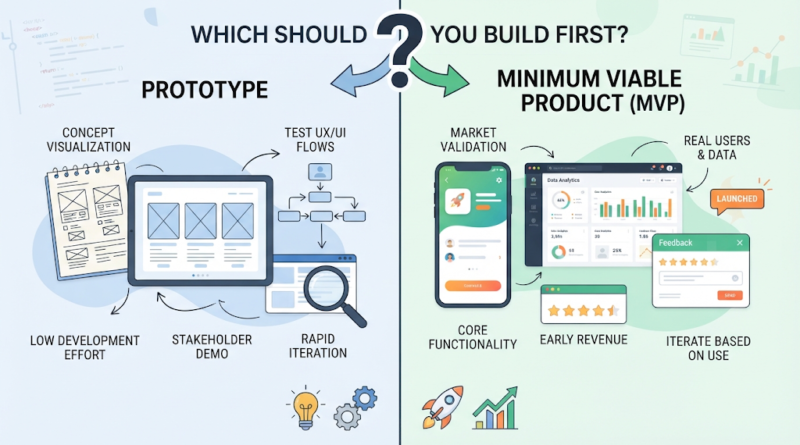
At their core, prototypes and Minimum Viable Products (MVPs) serve fundamentally different stages of the product lifecycle. They answer different questions, require vastly different levels of engineering effort, and target entirely different audiences.
A prototype is an exploratory model of your software designed to test an idea, layout, or workflow. It is built to visualize a concept, test user experience (UX) patterns, and communicate your vision to investors or team members. Often, a prototype is interactive—meaning clicking a button takes you to the next screen—but underneath the hood, there is no real database, business logic, or secure backend.
An MVP, on the other hand, is the simplest functional version of your software that delivers core value to real users and allows you to gather verified learning with minimum effort. An MVP is not a half-baked sketch; it is a working piece of software deployed in the real world to solve a genuine problem.
Quick Comparison: Prototype vs. MVP
When a Prototype Makes More Sense Than an MVP
Choosing when to build a prototype usually comes down to uncertainty around design, user experience, or technical feasibility. If your software concept involves an entirely novel user workflow or complex multi-user interactions, jumping straight into coding is a recipe for expensive rework.
Consider a founder building a specialized B2B logistics platform. Before writing code to integrate complex freight-tracking APIs, building a clickable software prototype allows them to test whether warehouse managers can intuitively navigate the dashboard.
You should prioritize software prototype development when you need to:
-
Demonstrate a product idea to stakeholders: If you need to secure internal buy-in or show an early vision to angel investors, a high-fidelity prototype provides a tangible representation of your concept without burning engineering capital.
-
Test UX/UI and user flows: Prototypes let you watch real users interact with your interface. Finding out that a primary navigation menu is confusing takes minutes to fix in a design tool, but weeks to rewrite in production code.
-
Explore technical feasibility: Sometimes, you need a proof-of-concept (a specialized type of technical prototype) to verify whether a specific algorithm, third-party integration, or data pipeline will actually work before committing to full architecture.
-
Validate assumptions before committing resources: If your core business model relies on a unique user engagement loop, testing it with a lightweight prototype prevents you from building features nobody wants.
When Building an MVP Is the Smarter Move
There comes a point in every product’s lifecycle where mockups and click-through screens are no longer enough. Knowing when to build an MVP means recognizing that your primary risk is no longer design clarity or concept visualization—it is market demand.
An MVP crosses the line from illusion to reality. It features real code, handles actual user data, and performs the core function of your software product from end to end.
Imagine you are launching an online marketplace for local artisanal services. A prototype can show investors how clean the booking interface looks. However, to find out if customers will actually input their credit cards, book a service, and trust the platform, you need a functional MVP.
Building an MVP is the right move when:
-
You need to test real-world usage: Simulated clicks do not yield behavioral data. An MVP tracks what users actually do, where they drop off, and which features they ignore.
-
You are validating willingness to pay: Real market validation requires real stakes. An MVP allows you to process payments, test pricing tiers, and measure true commercial viability.
-
You want to launch quickly with essential functionality: Instead of waiting 12 months for a feature-bloated “complete” product, an MVP lets you ship the single core feature that solves your users’ most pressing problem.
-
You are ready to build a customer feedback loop: An MVP gives early adopters a working tool, opening the door for qualitative feedback and feature requests that shape your product roadmap.
The Costs, Risks, and Trade-Offs You Need to Consider
Every product decision involves trade-offs between speed, cost, and risk. Evaluating minimum viable product vs prototype requires a clear-eyed look at what happens when you choose the wrong path.
The Cost Equation
While it is impossible to attach a universal price tag to software development—costs vary wildly depending on your technology stack, geographic talent distribution, third-party integrations, and UX complexity—prototypes are almost universally faster and cheaper to produce than MVPs. A prototype relies on design software and front-end mockups, whereas an MVP requires database architecture, security compliance, hosting infrastructure, and robust backend engineering.
Major Risks to Avoid
-
Building too much too early: Many founders fall into the trap of treating an MVP like a miniature version 1.0. They spend six months building secondary features, exhausting their budget before ever testing core assumptions.
-
Skipping validation entirely: Writing code without first testing wireframes or user flows often leads to building a technically sound product that completely misses market needs.
-
Mistaking positive prototype feedback for demand: Investors and friends will often praise a well-designed prototype. Polite encouragement, however, is not the same as a customer pulling out a credit card. Do not mistake aesthetic approval for product-market fit.
-
Overengineering an MVP: An MVP should be minimal. If your codebase is built to scale to millions of users on day one before you have even validated your first ten customers, you have overengineered.
A Simple Framework for Choosing Your Next Step
To determine whether your software idea needs a prototype, an MVP, or both, run your concept through this practical decision framework:
-
What is your primary risk right now?
-
If the risk is usability or concept clarity: Start with a prototype.
-
If the risk is market demand or willingness to pay: Move directly toward an MVP.
-
-
Do users need to complete a real transaction or data process?
-
If yes, mockups will fall short; you need functional MVP development.
-
-
Do you need to secure early capital or stakeholder alignment?
-
A high-fidelity prototype is often the ideal tool for pitch decks and stakeholder presentations.
-
-
Can you test your core value proposition without writing production code?
-
If you can validate demand using landing page tests, concierge services, or clickable mockups, do that before committing to engineering expenses.
-
For many startups, the optimal product evolution follows a natural progression: Idea → Prototype (for UX and stakeholder alignment) → MVP (for market validation and early revenue) → Full Product. However, if your concept builds on well-understood software patterns and your main challenge is executing a specific workflow for paying customers, you can reasonably bypass the prototype phase and begin MVP development right away.
Turn Your Idea Into a Market-Ready Product
Deciding whether to build a prototype or an MVP doesn’t have to be a guessing game. Aligning your development strategy with your current validation goals saves capital, reduces technical debt, and accelerates your path to product-market fit.
If you have a software idea and want expert guidance on whether you need a prototype, an MVP, or a custom development roadmap, our team is here to help. Contact us today to schedule a product strategy consultation, and let’s define the most practical, cost-effective path forward for your business.
