
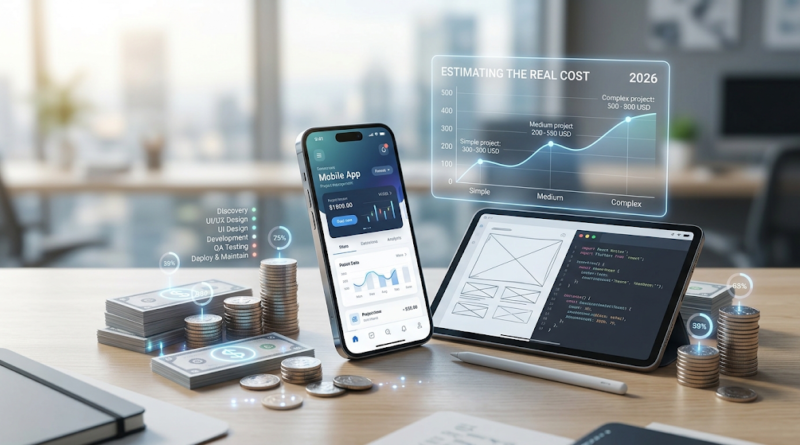
Mobile App Development Cost in 2026: The Real Price
Mobile app development cost in 2026 is one of the most frustrating variables for founders to pin down. You pitch your product roadmap to three different software agencies. Agency A quotes $25,000. Agency B says $75,000. Agency C insists you need at least $150,000.
Why the massive gap? Because asking what an app costs is a lot like asking a contractor how much it costs to build a house. Are you looking for a functional three-bedroom home or a custom-built commercial facility?
Accurate budgeting requires looking past vague estimates and breaking down the specific architectural variables, feature sets, and operational requirements that drive pricing. This guide will demystify app development pricing, break down realistic budget tiers, expose the hidden fees, and give you a framework to secure an accurate technical quote.
The Real Mobile App Development Cost in 2026: A Breakdown
When forecasting the mobile app development cost in 2026, you need realistic baselines. While every project is unique, we can categorize development into three broad tiers based on complexity, architecture, and feature sets.
Note: The following figures are illustrative USD ranges representing custom development by an experienced, mid-tier international software development team. Actual costs fluctuate based on the agency’s location, the technology stack, and specific compliance requirements.
1. The Simple App or Minimum Viable Product (MVP): $15,000 – $35,000
A simple app or MVP focuses on testing a core hypothesis with real users. It prioritizes essential functionality over complex custom animations or deep third-party integrations.
-
What this budget includes: Standard UI/UX design based on established patterns, core user authentication (email/password), basic database functionality, and up to five main screens.
-
Typical timeline: 2 to 4 months.
-
Examples: Internal company directory apps, simple task trackers, or an early-stage content delivery app.
2. The Medium-Complexity Business App: $40,000 – $80,000
Most successful B2B SaaS mobile extensions and consumer-facing startups fall into this tier. These applications require a more robust architecture, custom backend development, and a polished user interface to compete in crowded markets.
-
What this budget includes: Custom UI/UX design, payment gateway integrations (Stripe, PayPal), real-time messaging, third-party API connections, custom backend logic, and comprehensive Quality Assurance (QA) testing.
-
Typical timeline: 4 to 7 months.
-
Examples: E-commerce applications, on-demand service platforms, or fitness tracking apps with hardware synchronization.
3. The Complex App with Advanced Features: $90,000 – $200,000+
Enterprise-grade applications and platforms relying on highly specialized technologies require larger teams and extensive testing protocols.
-
What this budget includes: Artificial Intelligence (AI) or machine learning algorithms, high-frequency real-time data processing, complex custom animations, stringent security and compliance (such as HIPAA or GDPR), microservices architecture, and extensive offline capabilities.
-
Typical timeline: 7 to 12+ months.
-
Examples: Telehealth platforms, trading and fintech applications, or AI-driven personalized recommendation engines.
Development Cost vs. Total Cost of Launch It is critical to distinguish your engineering budget from your total go-to-market cost. The ranges above cover design, engineering, project management, and QA testing. They do not include marketing, user acquisition, legal fees, or the operational costs required to actually launch and run the business.
Why Two Apps With Similar Features Can Have Very Different Quotes
It is entirely possible to receive two vastly different quotes for apps that look identical on paper. So, what factors make mobile app development more expensive? The answer usually lies beneath the surface—in the software architecture, scale, and specific engineering choices made during the planning phase.
Key Factors That Drive Up Costs
-
Backend Architecture: Relying on a Backend-as-a-Service (BaaS) like Firebase is highly cost-effective for early startups. Building a custom, scalable backend infrastructure from scratch requires significantly more engineering hours but offers better long-term control.
-
Design Customization: Using standard native UI components is fast and economical. Requesting highly customized, brand-specific UI animations and screen transitions requires dedicated design and front-end engineering time.
-
Security and Compliance: Standard data encryption is manageable. Building an app that must pass rigorous financial or healthcare compliance audits requires specialized developers, heavy documentation, and third-party penetration testing.
-
Developer Location: A senior engineering team based in San Francisco or London will charge significantly more per hour than a highly skilled team based in Eastern Europe or Latin America, directly impacting the final budget.
Practical Example: The Delivery App Comparison
To illustrate why quotes vary, imagine two founders building a local food delivery app. Both apps allow users to browse menus, order food, and pay.
If you ask an agency for a “food delivery app,” Agency A might quote you based on the budget-friendly approach ($40,000), while Agency B assumes you want the enterprise-grade approach ($120,000).
The Hidden Costs That Can Blow Your App Development Budget
Getting your application approved by Apple or Google is only day one. A major mistake product managers and founders make is allocating 100% of their capital to the initial build, leaving nothing for operations.
To accurately plan your mobile app development budget, you must account for post-launch reality.
Overlooked Expenses to Factor In
-
Server Hosting and Infrastructure: Cloud hosting (AWS, Google Cloud, Azure) scales with your user base. A small user base might cost $50 a month, while scaling can push hosting into thousands of dollars monthly.
-
Third-Party APIs and Software Licenses: Services like Twilio (for SMS verifications), SendGrid (for emails), or specialized AI processing APIs charge per usage.
-
App Store Fees: Both Apple and Google charge developer account fees, and they take a standard commission (typically 15% to 30%) on digital goods sold natively within the app.
-
Security Updates and OS Changes: iOS and Android release major updates annually. Your app will require code adjustments to remain compliant, secure, and functional on the latest devices.
-
Ongoing Maintenance and Bug Fixes: No app is flawless at launch. You will need dedicated developer hours to address user-reported bugs and performance issues.
The App Budgeting Framework
As a general industry rule of thumb, expect to spend 15% to 20% of your initial development cost annually on maintenance and support. If you spend $60,000 to build your app, you should actively budget roughly $9,000 to $12,000 for the first year of post-launch hosting, maintenance, and vital updates.
MVP, Cross-Platform, or Native: Which Approach Fits Your Budget?
Your choice of technology stack directly dictates your initial app development pricing, time-to-market, and long-term scalability. There is no universally “best” approach—only the right approach for your current business objectives.
Native Development (Swift for iOS, Kotlin for Android)
Native development means writing separate codebases specifically for iOS and Android devices.
-
The Cost: Because you are essentially building two separate applications, the combined iOS and Android app development cost is the highest of the three approaches.
-
The Trade-off: Native apps offer the highest possible performance, the smoothest user experience, and direct access to device hardware (like advanced camera features or Bluetooth).
-
Best For: High-performance apps, graphics-heavy games, or products where a flawless, device-specific user experience is the primary competitive advantage.
Cross-Platform Development (Flutter, React Native)
Cross-platform frameworks allow engineers to write a single codebase that runs on both iOS and Android.
-
The Cost: The cross-platform app development cost is highly attractive for startups. Because you are maintaining one codebase, you can often save 30% to 40% compared to native development.
-
The Trade-off: While performance is excellent for most business apps, cross-platform apps can sometimes feel slightly less “native” and may require extra configuration for highly specialized hardware integrations.
-
Best For: B2B applications, SaaS mobile extensions, e-commerce platforms, and startups looking to hit both markets quickly without doubling their budget.
The Minimum Viable Product (MVP) Approach
The MVP strategy isn’t a technology stack, but a project management philosophy. It involves strictly limiting the app to its core, non-negotiable features.
-
The Cost: The lowest initial investment.
-
The Trade-off: You will launch with a bare-bones product that lacks the polish of established competitors.
-
Best For: Early-stage founders validating a new concept, securing initial seed funding, or testing market demand before committing to a six-figure build.
How to Get an Accurate App Development Quote Before You Build
The best way to avoid getting a $150,000 quote for a $40,000 idea is to control the variables before you approach an engineering team. Follow this step-by-step process to secure reliable development estimates.
-
Document a Strict Scope: Do not pitch an idea; pitch a feature list. Write down exactly what a user must be able to do. Differentiate strictly between “must-have” features for launch and “nice-to-have” features for version 2.0.
-
Map Out Integrations: List any external software your app must talk to. Do you need to integrate with your existing Salesforce CRM? Does it need to pull data from a specific public API?
-
Define Your Target Platforms: Clearly state if you are looking for iOS only, Android only, or a cross-platform solution.
-
Request an Itemized Breakdown: When evaluating an agency, never accept a flat lump-sum quote. Demand a proposal that breaks down estimated hours by category: Project Management, UI/UX Design, Front-End Development, Back-End Development, and QA Testing.
-
Assess the Partner’s Discovery Process: A reputable software development company will not give you a final quote after a 15-minute phone call. They will insist on a technical discovery phase to map the architecture, flag potential risks, and finalize the exact scope before committing to a price.
By understanding the true mobile app development cost in 2026, mapping out your long-term operational budget, and communicating exact technical requirements, you can eliminate the guesswork and partner with an agency that delivers high-quality code without financial surprises.
Ready to move past rough estimates and get real numbers? If you are preparing to build a mobile application and need a transparent, technically sound assessment, we can help. Contact our engineering team today to schedule a custom project discovery session and receive a detailed development roadmap for your software.
