
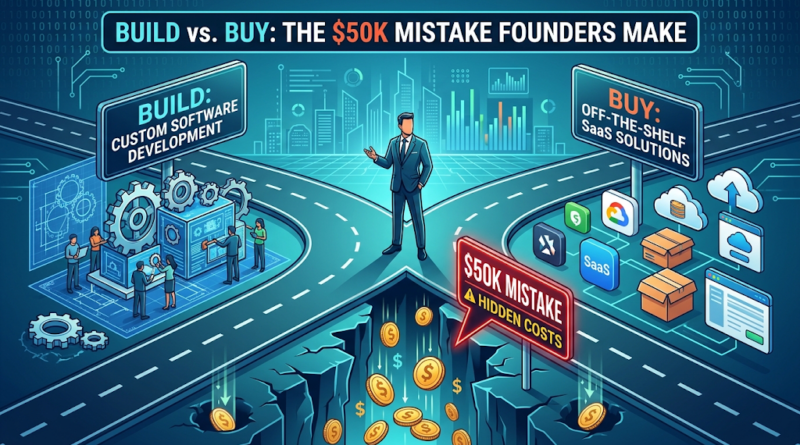
Build vs. Buy: The $50K Mistake Founders Make
Imagine signing an annual contract for a premium enterprise SaaS platform, only to discover six months later that it doesn’t seamlessly integrate with your company’s core database. To keep operations running, your engineering team is forced to spend weeks building fragile, custom workarounds. Then, the vendor arbitrarily raises their API limits, forcing your company into a much higher pricing tier. What started as a highly affordable, off-the-shelf solution has now drained significant capital, stalled your product roadmap, and burned out your developers.
Welcome to the complex, high-stakes reality of build vs. buy software.
Every startup founder, CTO, and business leader eventually faces this exact crossroads. Do you invest upfront capital in custom software development to maintain total control over your tech stack, or do you license an existing product for immediate deployment? Make the right call, and you accelerate your time to market while preserving cash. Make the wrong one, and you risk a silent, compounding financial drain.
This guide breaks down the true financial impact of this choice and provides a proven framework to help you navigate the build vs. buy decision without compromising your company’s runway or technical future.
The $50K Mistake Starts Before You Write a Single Line of Code
When companies lose money on a poor software strategy, it rarely happens in one catastrophic event. Instead, the $50K mistake is a realistic, illustrative scenario of how hidden costs quietly accumulate when a technology decision is made without analyzing the long-term operational impact.
Consider the scenario of buying an off-the-shelf product. You find a SaaS platform with a licensing fee of just $1,000 per month. On paper, it looks drastically cheaper than hiring a development team. But the hidden costs quickly begin to stack up. First, your team realizes the software requires heavy configuration. You pull two senior engineers off your core product for a month to manage data migration and build custom API integrations. Assuming a blended engineering rate of $100 per hour, that 300-hour detour just cost you $30,000 in diverted labor. Add in the cost of hiring an external implementation consultant, the workflow friction of training your staff, and the opportunity cost of delayed product features, and you have easily wasted $50K on a supposedly “cheap” solution before realizing any actual value.
The custom software vs. off-the-shelf debate works both ways. The $50K mistake is just as common when founders decide to build everything from scratch. You might assume that building an internal CRM will save you money on Salesforce licenses. But an initial $40,000 build can quickly balloon into a technical debt nightmare. If that internal tool requires just 10 hours a week of ongoing developer maintenance to fix bugs and patch security vulnerabilities, you are bleeding thousands of dollars a month just to keep the lights on.
In both scenarios, the mistake isn’t necessarily the software itself—it is the failure to accurately forecast the hidden operational costs of the path chosen.
Build vs. Buy Software: Which Option Actually Wins on Total Cost?
Comparing the true buy vs. build software cost requires looking far beyond the initial price tag or the first year’s subscription fee. To understand which option actually wins financially, you must evaluate the Total Cost of Ownership (TCO) across the entire lifespan of the tool.
Core Components of Total Cost of Ownership
-
Upfront Capital Expenditure: Buying software requires minimal upfront investment beyond standard setup fees and initial licensing. Building custom software requires a massive initial outlay for scoping, UX/UI design, development sprints, and testing.
-
Recurring Operational Costs: Off-the-shelf software locks you into perpetual subscription fees that often scale with your headcount. Custom software eliminates third-party licensing fees entirely, though it introduces cloud hosting and infrastructure costs.
-
Maintenance and Upgrades: When you buy, the vendor is responsible for security patches, feature updates, and server uptime. When you build, your internal team owns the codebase forever. If a third-party API changes, your engineers must fix it on your dime.
-
Time to Market: A SaaS product can often be deployed in a matter of days or weeks. A custom build will take months, delaying the operational benefits the software is supposed to provide.
To illustrate how TCO diverges over time, let’s look at a hypothetical 3-year cost estimate comparing an enterprise SaaS platform to a custom internal build for a mid-sized team.
Note: This table is an illustrative estimate. Actual costs will vary heavily based on engineering rates, user count, and technical complexity.
In this specific scenario, buying appears cheaper over a three-year horizon. However, the financial logic can completely flip depending on how rapidly your company scales.
When Buying Software Becomes More Expensive Than Building
There is a distinct operational tipping point where renting software becomes a punitive tax on your company’s growth. While off-the-shelf platforms are excellent for getting off the ground quickly, you must recognize the scenarios where buying becomes vastly more expensive than building.
The Per-Seat Pricing Trap
Most enterprise software relies on a per-seat or usage-based pricing model. This works perfectly when you have a small team. But if your startup hits hyper-growth, that pricing model becomes a liability. If a tool costs $100 per user per month, a 20-person team pays a manageable $24,000 a year. If you scale to 300 employees, you are suddenly paying $360,000 annually for the exact same functionality. At that scale, the ROI of a custom build becomes undeniable.
The Feature Tier Ransom
When you analyze whether to build or buy SaaS, you must scrutinize the vendor’s pricing tiers. Often, a crucial compliance feature—like Single Sign-On (SSO), HIPAA compliance, or custom data residency—is locked behind an “Enterprise” tier. You might only need that one specific feature, but you are forced to upgrade your entire user base, multiplying your software bill by three or four times overnight.
Workflow Friction and Customization Ceilings
SaaS products are fundamentally designed for the masses, meaning they aim for the lowest common denominator of functionality. When your business operations become highly specialized, standard tools break down. If your team is spending countless hours exporting data to spreadsheets because your off-the-shelf software lacks custom reporting, the tool is actively costing you money in lost productivity.
Vendor Lock-In
Once your critical business data is deeply entrenched in a proprietary third-party system, leaving becomes agonizingly difficult. Vendors understand this friction, which is why renewal prices often spike year over year. If you cannot easily extract your data and migrate to a competitor, you have lost control over a segment of your operating budget.
The Founder’s Decision Framework: Speed, Control, and ROI
How do top-tier executives consistently maximize their software development ROI? They do not rely on gut feelings; they apply a rigorous, objective framework to every major technology investment. Before allocating budget, run your requirements through these three crucial filters.
1. The Core Competency Test
Is the software you need directly related to your company’s unique value proposition?
-
If Yes (Build): If a piece of software is your competitive differentiator, you must own it. A logistics company should build its proprietary route-optimization algorithm. A fintech startup must build its own transaction-matching engine. Relinquishing control of your core IP to a third-party vendor is strategic suicide.
-
If No (Buy): If the software does not differentiate you in the market, buy it. No customer buys your product because you have a brilliant, custom-built HR portal or internal payroll system. License the best off-the-shelf tool and move on.
2. The 80/20 Rule of Functionality
Can an existing platform satisfy 80% of your business requirements out of the box? If you can achieve the vast majority of your workflow goals with a commercial product, the remaining 20% is rarely worth the cost of a custom build from scratch. You are usually better off adapting your internal processes to match the software, rather than spending six figures to make the software match your processes.
3. The True Time-to-Market Requirement
How quickly does this technology need to be operational to capture market share or fix a critical bottleneck? If a major client deal hinges on having a specific capability live in two weeks, buying is your only option. If this is a strategic asset meant to scale over the next five years, and you have a six-month runway to perfect it, investing in a custom build is fully justified.
A Practical Example: Consider Sarah, the founder of a scaling e-commerce fulfillment startup. She urgently needed a warehouse management system (WMS) and a customer service ticketing portal. Using this framework, she realized that world-class customer service ticketing software already existed. She bought an off-the-shelf SaaS tool for ticketing, saving hundreds of development hours. However, standard warehouse tools couldn’t handle her company’s unique automated robotics sorting. Because the sorting logic was her primary competitive advantage, she invested heavily to build a custom WMS. This calculated approach prevented a costly misallocation of engineering resources.
How to Avoid a Costly Software Decision Before It Happens
Knowledge without action will not protect your balance sheet. To ensure you make a financially sound decision, implement these critical safety checks before signing a contract or authorizing a development sprint.
Exhaustively Map Your Requirements
Do not just write a loose list of desired features. Document the actual user journeys of the employees or customers who will use the software. What legacy systems does this new tool absolutely have to integrate with? Clearly separate your non-negotiable “must-haves” from your “nice-to-haves.” Many founders realize they can buy an existing tool once they strip away vanity requirements.
Model a 3-to-5 Year TCO
Never make a decision based on Year 1 costs alone. Build a comprehensive spreadsheet mapping out a multi-year timeline. For off-the-shelf tools, forecast user growth and factor in standard vendor price hikes. For custom builds, estimate an additional 15% to 20% of the initial development cost annually for ongoing maintenance, bug fixes, and server infrastructure.
Run a Time-Boxed Proof of Concept (PoC)
Never commit blindly. Before locking into a massive enterprise contract, insist on a 30-day pilot program with a small cohort of your most technical users to test actual functionality against the vendor’s sales pitch. Similarly, before greenlighting a $100,000 custom build, invest a fraction of that cost into a clickable prototype or a minimal viable product (MVP) to validate your assumptions.
Explore a Hybrid Architecture
Often, the smartest answer isn’t purely building or buying—it’s a hybrid approach. You might license a powerful, headless backend via an API (buying the complex infrastructure) while having your engineering team build a completely custom front-end interface (building the user experience). This gives you the speed of off-the-shelf software with the exact branding and workflow control of a custom application.
Don’t Make the Decision in an Echo Chamber
Navigating the complexities of technology investments doesn’t have to be a solo endeavor for leadership teams. Working with an experienced software development partner can bring objective, technical clarity to the table. A strong technical partner won’t just blindly write code; they will audit your requirements, provide realistic architectural cost estimates, and help you evaluate off-the-shelf alternatives to ensure you are making a data-driven choice.
Are you currently weighing the risks of a major technical investment? Don’t let hidden costs and architectural missteps derail your company’s growth. Reach out to our team today to discuss your specific requirements, rigorously assess your build vs. buy options, and request a comprehensive software discovery consultation.
