
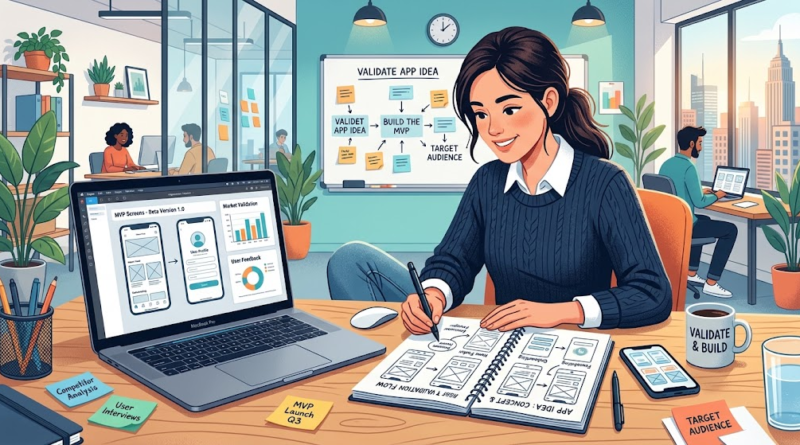
How to Validate an App Idea in 7 Days Without Code
Spending weeks or months building a mobile or web application only to launch and discover that nobody wants to use or pay for it is one of the most expensive mistakes a founder can make. Too many entrepreneurs fall in love with their solution before verifying whether the underlying problem actually matters to a paying audience. If you have ever wondered how to validate an app idea without risking your savings on premature software development, you are not alone.
You do not need a line of code, an expensive design agency, or a massive marketing budget to test market demand. By committing to a structured seven-day sprint, you can systematically investigate your target market, talk to potential users, analyze competitors, and run low-friction demand tests. This guide provides a practical, step-by-step roadmap to help you validate an app idea quickly, objectively, and without writing a single line of code.
Day 1: Define the Problem Your App Will Actually Solve
The most common trap for first-time founders is becoming attached to a specific feature set—such as a sleek dashboard, custom animations, or AI-powered recommendations—before clearly defining the pain point. On Day 1, your objective is to strip away your preconceived solutions and focus entirely on the core problem.
To validate a startup idea, you must define who experiences the problem, exactly when it happens, and why current workarounds fail. Let’s look at a concrete example: Sarah, an independent personal fitness trainer, spends hours every week texting clients to confirm bookings, rescheduling missed sessions, and chasing late payments. Her vague initial idea was “an app for fitness professionals.” On Day 1, she narrows this down to a specific problem: Independent fitness coaches lose time and revenue due to manual scheduling friction, last-minute cancellations, and disorganized client follow-ups.
Use this simple problem-statement template to clarify your focus:
Target User: [Specific customer persona, e.g., independent personal trainers with 10–30 active clients] Core Problem: [Specific frustration, e.g., spending 5+ hours weekly managing bookings and manual reminders via text] Current Workaround: [How they solve it today, e.g., a messy combination of calendar apps, spreadsheets, and WhatsApp messages] The Failure: [Why the workaround falls short, e.g., double bookings and high client no-show rates]
Deliverable for Day 1: A single-page document outlining your target user, their exact problem, their current workarounds, and a testable hypothesis about the value your app could provide.
Days 2–3: Find Your Target Users and Test Their Pain Points
Once you have defined the problem, you need to find out if real people experience it acutely enough to look for a better solution. This phase of app idea validation requires talking directly to potential users rather than relying on assumptions or asking friends and family who might be too polite to give honest feedback.
How to Find and Interview Potential Users
Start by identifying where your target audience congregates. For professional apps, this might include LinkedIn groups, specialized Reddit communities, Slack channels, industry forums, or your existing professional network. Reach out with a short, polite message explaining that you are researching workflow challenges in their industry and would value 15 minutes of their expertise—no sales pitch involved.
When conducting customer discovery interviews, ask open-ended questions that uncover past behavior rather than hypothetical future preferences.
-
Can you walk me through how you currently handle [problem area] today?
-
What is the most frustrating part of that process?
-
How much time or money does this problem cost you each month?
-
What tools or workarounds have you tried, and why did you stop using them?
-
When was the last time this happened, and what did you do about it?
Avoid leading questions like, “Would you use an app that automatically schedules your clients?” People will almost always say yes to be polite. Instead, look for evidence of pain. True demand is demonstrated through action: someone agreeing to a follow-up call, sharing specific metrics about how much money they lose to the problem, or asking when your solution will be ready.
Deliverable for Days 2–3: Complete 5 to 10 short interviews, record recurring pain points in a simple spreadsheet, and look for patterns that confirm whether the problem is urgent, painful, and frequent.
Day 4: Analyze Competitors Without Copying Their Ideas
Many founders panic when they discover existing competitors, assuming an occupied market means there is no room for them. In reality, competition is proof that a market and willingness to pay already exist. On Day 4, your goal is to evaluate the competitive landscape through rigorous app market validation.
Map out three categories of competitors:
-
Direct Competitors: Established software products addressing the exact same problem.
-
Indirect Competitors: Software products solving adjacent problems that users might substitute.
-
Non-Digital Alternatives: Manual workarounds, such as spreadsheets, paper notebooks, or messaging apps.
Competitor Comparison Framework
Evaluate competing solutions using these criteria:
-
Core Strengths: What do users praise in their reviews?
-
Primary Weaknesses: What do customers complain about in online forums or app store reviews? (Look for phrases like “clunky,” “too expensive,” or “missing feature X”).
-
Pricing Model: How do they charge (subscription, one-time fee, freemium)?
-
Underserved Segments: Are small businesses, solo operators, or specific niches ignored in favor of enterprise clients?
For Sarah the fitness coach, researching competitors like general calendar scheduling tools and complex enterprise gym management software reveals a gap: existing tools are either too generic or overly bloated for a solo trainer. By identifying these gaps, you can refine your value proposition to focus on simplicity, speed, or specialized workflows tailored specifically to your audience.
Days 5–6: Build a No-Code Prototype and Test Real Demand
With a validated problem and a clear understanding of the competitive landscape, it is time to test whether people want your proposed solution. You do not need developers for this step. You need a no-code app prototype or a targeted landing page to understand how to test app demand effectively.
Choose the lightest test format that matches your concept:
-
A Simple Landing Page: A single-page website explaining the app’s value proposition with a clear call to action (e.g., “Join the Beta Waitlist”).
-
A Clickable Wireframe: Low-fidelity screen layouts built in tools like Figma or Canva that simulate the core user flow.
-
A Manual Service (Concierge MVP): Delivering the app’s core value manually behind the scenes for a few early users to prove the concept works.
Creating Your Experiment
-
Define Your Hypothesis: If we present solo fitness coaches with a streamlined booking workflow landing page, at least 15% of visitors will join our waitlist.
-
Build the Asset: Use a no-code landing page builder (such as Carrd or Webflow) to publish a clean page with a compelling headline, 3 key benefits, a visual mockup, and an email input field.
-
Drive Targeted Traffic: Share your landing page in the communities or networks where you conducted your Day 2–3 interviews.
Track meaningful validation signals—such as qualified waitlist sign-ups, requests for private demos, or willingness to put down a small refundable deposit—rather than vanity metrics like social media likes or casual page views. Remember that a landing page sign-up is an early signal of interest, not definitive proof of commercial viability, but it provides tangible evidence that your message resonates.
Day 7: Read the Results and Decide Whether to Build
On the final day, compile all the data you gathered throughout the week: your interview notes, competitor insights, prototype engagement, and demand signals. Step back and separate objective evidence from your personal enthusiasm.
Use this simple decision framework:
-
Proceed: Interviewees confirmed high pain, competitors have clear vulnerabilities, and your landing page achieved strong conversion rates (e.g., 10–20%+ of targeted visitors joining a waitlist). You are ready to scope a minimal viable product (MVP).
-
Refine: Users acknowledge the problem, but your proposed value proposition missed the mark or targeted the wrong audience. Adjust your positioning, tweak the feature scope, and run a secondary test.
-
Pause or Pivot: Engagement was extremely low, people do not care about the problem, or existing workarounds are deemed “good enough.” Save your capital and explore a different concept.
Your 7-Day Validation Checklist
-
[ ] Defined a specific user problem and written a clear problem statement (Day 1).
-
[ ] Completed at least 5 structured customer discovery interviews (Days 2–3).
-
[ ] Analyzed direct and indirect competitors to find market gaps (Day 4).
-
[ ] Built a lightweight no-code landing page or prototype (Days 5–6).
-
[ ] Measured real user demand through sign-ups, feedback, or engagement (Days 5–6).
-
[ ] Evaluated findings against a clear decision framework (Day 7).
Transitioning From a Validated Idea to a Reliable Digital Product
Once you have completed this seven-day validation sprint and gathered credible evidence of market demand, the next challenge is turning your validated concept into a robust, scalable digital product. This is where partnering with an experienced software development company makes all the difference.
Bringing in a technical partner after validation helps you navigate critical next steps without guesswork:
-
Defining MVP Scope: Distilling your validated concept into the leanest, most impactful feature set for version one.
-
Assessing Technical Feasibility: Ensuring your product architecture can support future growth and user volume.
-
Selecting the Right Technology Stack: Choosing modern web and mobile frameworks that balance speed-to-market with long-term maintainability.
-
Planning Security and Scalability: Designing secure data handling, robust user authentication, and seamless third-party API integrations.
If you have validated an app idea and are ready to turn your research into a functional web application, mobile app, or SaaS platform, our engineering team can help. Contact our experts today to discuss your project scope, assess technical feasibility, and plan your path to market.
