
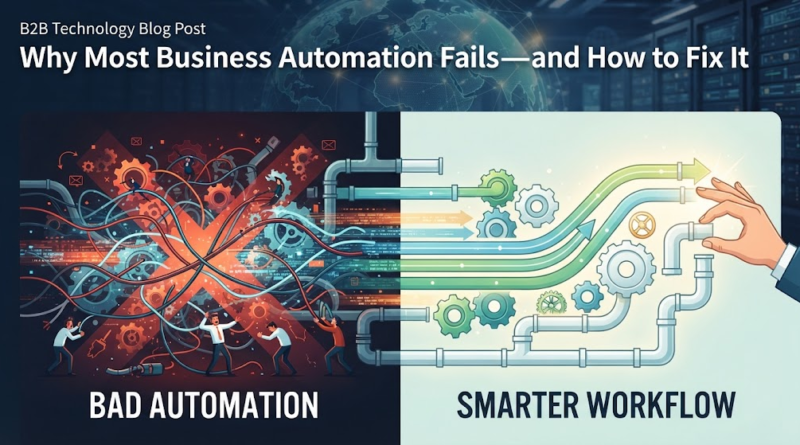
Why Most Business Automation Fails—and How to Fix It
A mid-sized logistics firm spent six weeks implementing a complex web of cloud integrations, connecting their CRM, billing software, and project management tools. On paper, the new setup promised to eliminate manual data entry entirely. Three months post-launch, error rates had actually doubled, customer support queues were overflowing with confused clients receiving conflicting automated emails, and internal teams were spending ten hours a week troubleshooting broken API connections. The company hadn’t solved an operational bottleneck; they had simply mechanized chaos.
This scenario plays out across startups, growing enterprises, and established institutions every single day. Organizations rush to adopt the latest business automation tools, driven by the fear of falling behind competitors or the allure of instant productivity gains. Yet, without a deliberate automation strategy, technology often amplifies existing inefficiencies rather than curing them. Understanding why automation fails—and how to approach it with precision—is critical for leaders looking to scale sustainably.
Automation Isn’t the Problem. Bad Automation Is
At its core, business automation is designed to remove friction, reduce human error, and free up valuable talent for high-impact work. However, a foundational rule of operations often gets overlooked: automating a bad process does not make it better; it merely makes a bad process happen faster.
When companies attempt to automate unstructured, poorly understood, or fundamentally flawed workflows, they cement those flaws into code and software rules. Instead of diagnosing why a process is slow or error-prone, teams throw software at the symptom.
This rush is frequently fueled by market pressure. Competitors are talking about AI-driven workflows and streamlined operations, prompting leadership to demand immediate digital transformation. But adopting business process automation without first auditing the underlying workflow is like paving a cowpath—you end up with a fast route to nowhere. True efficiency requires diagnosing the root cause of operational friction before deciding whether software, code, or human oversight is the appropriate remedy.
The 5 Signs You’re Automating the Wrong Things
Before writing a single workflow rule or purchasing enterprise software, decision-makers must evaluate whether the target process is actually ready for prime time. Common automation mistakes often stem from targeting the wrong operational areas.
1. The Process Lacks Standardization
If three different team members handle a customer onboarding task in three different ways, you cannot automate it. Automation requires predictable inputs and consistent rules. Trying to script a moving target results in endless edge-case failures and broken workflows.
2. The Task Requires Empathy and Nuance
Automating sensitive client communications, nuanced dispute resolution, or complex negotiations often alienates customers. While intelligent workflow automation can handle routine data triage, substituting machine logic for human judgment in emotionally charged scenarios destroys trust.
3. You Chose the Software Before Mapping the Workflow
Letting off-the-shelf software dictate your internal operations is a recipe for friction. When teams bend their processes to fit rigid SaaS limitations rather than defining their ideal workflow first, they create workarounds that defeat the entire purpose of efficiency gains.
4. The Maintenance Burden Exceeds the Savings
If an automated workflow requires constant debugging, manual intervention, and weekly API adjustments just to stay operational, the net labor savings evaporate. Maintenance overhead is a hidden tax on poorly designed systems.
5. There Are No Baseline Metrics
If you cannot measure how long a manual process currently takes, what it costs in labor, and what its error rate is, you will never know if your workflow automation actually succeeded. Guesswork is not a metric.
Where Business Automation Goes Off the Rails
Even when organizations pick viable processes, implementation often derails due to structural missteps.
One major pitfall is over-complication. Eager teams build sprawling, multi-tiered Rube Goldberg workflows that require an engineering degree to maintain. When a single step fails in a twenty-step automated chain, tracing the error becomes an investigative ordeal.
Another frequent failure is data siloing. Modern companies use dozens of specialized SaaS applications. When automated pipelines are hastily patched together without robust system integration, data inconsistencies multiply. Customer records become fragmented, leading to conflicting information across billing, sales, and support platforms.
Furthermore, companies often treat automation as a one-time project rather than an ongoing operational discipline. Business environments shift, pricing models change, and customer expectations evolve. An automated workflow left unmonitored for six months is an operational liability waiting to explode.
A Smarter Framework for Choosing What to Automate
To avoid costly missteps, organizations need a disciplined methodology. A reliable framework for how to automate business processes follows six sequential stages:
-
Identify: Pinpoint high-volume, repetitive, rule-based bottlenecks where human error frequently creates downstream friction.
-
Simplify: Strip away legacy redundancies, unnecessary approvals, and convoluted steps before introducing any technology. Never automate waste.
-
Measure: Establish clear quantitative baselines—such as processing time, error frequency, and operational cost—to track future impact.
-
Automate: Implement targeted workflow solutions, choosing between adaptable custom software or configured business automation tools based on complexity.
-
Monitor: Track real-time performance, exception rates, and user feedback to ensure the system behaves as expected under live conditions.
-
Improve: Treat the automated process as a living system, continuously refining rules, handling edge cases, and adapting to business growth.
How to Build Automation That Actually Moves the Business Forward
Applying this framework transforms automation from a speculative experiment into a strategic growth driver. Consider how this plays out across different operational domains:
-
Finance & Invoicing: Instead of blindly scripting automatic payment retries that trigger bank fees on failed accounts, intelligent workflow automation can parse incoming invoices, flag anomalies for human review, and streamline approval chains for standard billing cycles.
-
Sales & Lead Management: Rather than bombarding prospects with tone-deaf, rigid email sequences, businesses can use automated routing to instantly qualify inbound leads and deliver them to the right sales reps with enriched context, preserving the human touch where it matters most.
-
HR & Employee Onboarding: Automating document collection and credential provisioning saves administrative hours, but pairing it with human-led mentorship ensures new hires feel culturally integrated rather than processed by a machine.
-
Customer Support: Deploying intelligent triage for tier-1 FAQs resolves minor issues instantly while guaranteeing seamless, context-rich handoffs to human specialists for complex troubleshooting.
Whether an organization relies on modular SaaS tools or bespoke software development to build these systems, the objective remains the same: amplify human capability, eliminate administrative drag, and build systems designed for long-term scalability.
Ready to Optimize Your Operations?
Implementing sustainable workflow automation requires more than installing software—it demands a strategic partner who understands how technology aligns with real-world business goals. Whether you need custom software development, AI-powered automation, or complete business process optimization, our engineering team is here to help you identify the right opportunities and build scalable, robust solutions. Get in touch with our experts today to start building smarter workflows.
