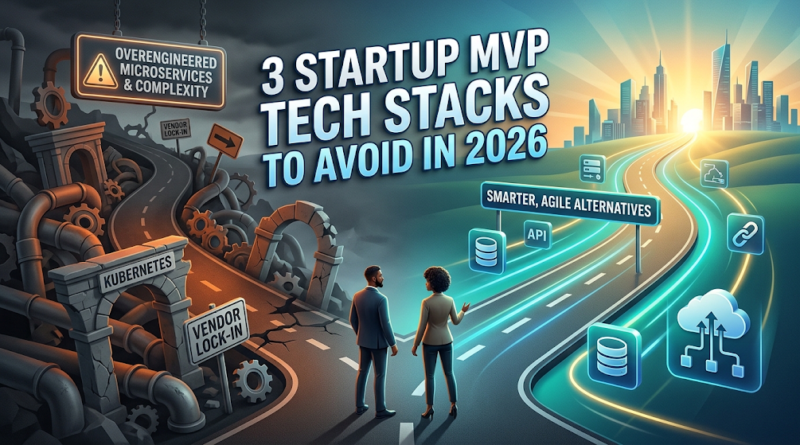
3 Startup MVP Tech Stacks to Avoid in 2026
The Hidden MVP Costs of Choosing the Wrong Tech Stack
Choosing the right startup MVP tech stack is often the difference between a rapid, successful launch and a depleted runway. Yet, a familiar trap catches many first-time founders: they secure early funding, hire a brilliant engineer from a tech giant, and immediately begin building an infrastructure designed to support ten million concurrent users. Six months later, the startup’s runway is half gone, the product still isn’t live, and the engineering team is spending more time managing cloud configurations than talking to actual users.
This happens when founders underestimate how deeply their startup technology stack impacts business outcomes. In the early stages of MVP development, your primary goal is validation. You need to get a functional product into the hands of real users as quickly and efficiently as possible to test your core hypothesis.
Choosing a highly complex or poorly aligned technology stack carries hidden costs. It drastically increases development time, inflates your engineering payroll, and makes future iterations sluggish. When a stack requires highly specialized talent, every new feature or bug fix becomes a bottleneck. Conversely, selecting a sensible, well-understood tech stack empowers your team to build quickly, pivot when the market demands it, and scale smoothly once you actually hit product-market fit.
3 Tech Stacks We’d Avoid for a Startup MVP
There is no objectively “bad” programming language, but there are definitively bad architectural choices for early-stage products. Here are three technology stacks and architectural approaches we generally steer founders away from when building an initial MVP.
1. The “Enterprise-Grade” Microservices Stack (Java/Spring Boot + Kubernetes)
What it consists of: This stack relies on heavyweight enterprise languages like Java (often using the Spring Boot framework) deployed across a distributed microservices architecture, usually orchestrated by Kubernetes.
Why it’s a poor choice for an MVP: Microservices solve organizational scaling problems, not product validation problems. If you have a team of 500 engineers, microservices allow different squads to deploy code independently. For a startup MVP with two or three developers, a microservices architecture introduces massive operational overhead. You will spend weeks configuring deployment pipelines, setting up inter-service communication, and debugging complex network errors instead of building core features. Furthermore, Java, while incredibly robust, requires significant boilerplate code, slowing down the rapid prototyping phase.
The trade-offs: You face an astronomically high time-to-market. Hiring senior DevOps engineers and Java specialists is expensive, and maintaining a Kubernetes cluster for an app with 100 beta users is a drain on your budget.
A realistic problem scenario: A B2B SaaS startup builds five separate microservices for user authentication, billing, notifications, core processing, and reporting. When they realize their core user flow is wrong and needs to change, developers must rewrite and redeploy three different services just to update one feature.
The smarter alternative: A “majestic monolith” built on frameworks like Ruby on Rails, Django (Python), or Laravel (PHP). These frameworks come with authentication, database routing, and security built-in, allowing a small team to move lightning fast. When to use Java/Microservices: When you are migrating a legacy enterprise application, operating in highly regulated banking environments, or scaling past hundreds of engineers.
2. The “Hype-Driven” Systems Stack (Rust/C++ for Standard Web Apps)
What it consists of: Building standard web backends using low-level systems programming languages like Rust or C++, often paired with experimental, bleeding-edge frontend frameworks or custom WebAssembly modules.
Why it’s a poor choice for an MVP: Rust is an exceptional language favored for memory safety and extreme performance. However, utilizing it for a standard web application—where you just need to save user data to a database and display it on a screen—is like using a Formula 1 car to go grocery shopping. The ecosystem for standard web conveniences (like out-of-the-box Stripe billing integrations, simple ORMs, or auth packages) is much smaller than established web languages.
The trade-offs: The talent pool for Rust and systems languages is relatively small and highly compensated. Development speed is much slower because developers have to manage low-level system constraints and often write their own integrations from scratch.
A realistic problem scenario: A founder wants to build a marketplace application and insists on a Rust backend for “future-proofing.” The development team spends three sprints building a custom payment gateway integration and handling memory allocation, while a competitor using Node.js builds the entire checkout flow in two days using pre-built libraries.
The smarter alternative: Node.js/TypeScript, Python, or Ruby. These ecosystems have millions of developers, endless third-party libraries, and documentation for almost every problem you will encounter. When to use Rust: When building core infrastructure, high-frequency trading platforms, intensive data-processing pipelines, or AI execution engines where raw computational speed is the product’s primary value.
3. The “Vendor-Locked” Pure Serverless NoSQL Stack (For Highly Relational Data)
What it consists of: Going 100% serverless using proprietary cloud functions (like AWS Lambda) paired exclusively with a NoSQL database (like DynamoDB or MongoDB) for everything.
Why it’s a poor choice for an MVP: Serverless and NoSQL are fantastic tools, but relying on them exclusively for an early-stage application with highly relational data is a trap. NoSQL databases require you to know your exact query access patterns in advance to model the data correctly. Startups, by definition, pivot. You will inevitably need to change how users interact with your data. If your data is relational (e.g., Users belong to Companies, Companies have Invoices, Invoices have Line Items) and you put it in a NoSQL database, pivoting your product often requires rewriting your entire database schema.
The trade-offs: While infrastructure costs might start at zero, the development cost of refactoring a NoSQL database every time you change a feature is immense. Furthermore, pure serverless architectures can become nightmare webs of disjointed functions that are notoriously difficult to debug locally.
A realistic problem scenario: An ed-tech startup builds its MVP using AWS DynamoDB. Three months in, they pivot from a B2C model to a B2B model, requiring complex reporting dashboards that connect student data to enterprise sponsors. Because NoSQL isn’t built for complex relational JOINs, the engineering team has to write thousands of lines of custom code just to generate a basic report.
The smarter alternative: A standard relational database like PostgreSQL. It is flexible, handles changing relationships gracefully, and scales massively. You can host it easily on managed services like Supabase, Heroku, or AWS RDS. When to use NoSQL/Serverless: When you are handling massive volumes of unstructured data, ingesting IoT sensor logs, or building a highly specific microservice that demands infinite, rapid scalability without complex relationships.
Why These Technologies Can Slow Your Product Launch
When you are exploring tech stacks to avoid for startups, the common denominator is usually unnecessary complexity. The technology you choose dictates how fast you can turn a user’s feedback into a live feature.
Overengineered architectures cripple your time-to-market. Let’s compare a lean MVP approach with an overly complex one:
-
Developer Onboarding: In a lean architecture (e.g., a Next.js frontend with a Node.js/PostgreSQL backend), a new developer can pull the code repository, run a single command, and start building locally in an hour. In a complex microservices/Kubernetes setup, it might take a new hire two weeks just to get their local development environment running.
-
Debugging: When a user reports a bug in a monolithic application, the error log tells you exactly where the application failed. In an event-driven serverless architecture, tracing an error requires jumping through five different cloud services to find the point of failure.
-
Deployment: A scalable MVP architecture should allow developers to push code to production multiple times a day with confidence. Complex stacks often require convoluted CI/CD (Continuous Integration/Continuous Deployment) pipelines that break frequently, slowing down product iteration.
By choosing simpler, proven technologies, you optimize for agility. You can always break a successful, profitable monolith into microservices years down the line when scaling demands it. You cannot, however, recover the lost time and money spent overengineering a product that nobody wanted to buy.
What to Build With Instead: Smarter Alternatives for Founders
If the best tech stack for a startup MVP is one that balances speed, cost, and reliability, what should you actually use? While the answer depends on your specific product, here are battle-tested combinations we frequently recommend:
For a SaaS Web Application
The Stack: Next.js (React) or Vue.js for the frontend, paired with Node.js or a framework like Ruby on Rails/Laravel for the backend, supported by a PostgreSQL database. Why it works: These stacks feature massive talent pools. If a developer leaves, you can easily find a replacement. They also support rapid development through abundant open-source libraries for standard SaaS features like authentication and billing.
For a Mobile-First Consumer Product
The Stack: React Native or Flutter for the mobile app, backed by a Backend-as-a-Service (BaaS) like Firebase or Supabase. Why it works: React Native and Flutter allow you to write one codebase and deploy it to both iOS and Android simultaneously. Using a managed BaaS eliminates the need to build a custom backend from scratch, cutting development time in half.
For an AI-Powered Product
The Stack: Python (using FastAPI or Django) for the backend, React for the frontend, and PostgreSQL with the pgvector extension for handling AI embeddings. Why it works: Python is the undisputed king of artificial intelligence and machine learning. By keeping your backend in Python, integrating with OpenAI, Anthropic, or custom HuggingFace models becomes seamless.
For a Data-Heavy or Enterprise-Oriented MVP
The Stack: Node.js (with NestJS) or .NET Core paired with a highly structured PostgreSQL database and hosted on managed cloud services like AWS Elastic Beanstalk or Vercel. Why it works: These frameworks enforce strong typing (via TypeScript or C#), which reduces bugs in complex business logic. They are inherently scalable and respected by enterprise clients who may audit your startup technology stack.
How to Choose an MVP Tech Stack That Scales With Your Business
Founders frequently ask two critical questions: What is the best tech stack for a startup MVP? and How do you choose a tech stack for an MVP without overspending?
The answer to both is a systematic evaluation of your unique constraints. Use this practical decision-making framework before writing your first line of code:
1. Product Complexity and Core Functionality
What is the actual core value of your product? If it is a beautifully designed consumer app, prioritize frontend technologies like React Native. If it requires heavy algorithmic processing, prioritize backend efficiency with Python or Node.js. Don’t optimize for problems you don’t have yet.
2. Development Speed and Available Talent
Your technology choice dictates who you can hire. It is much easier and cheaper to hire excellent React and Node.js developers than it is to find senior Go or Rust engineers. Choose a stack with a large, active developer community.
3. Budget and Total Cost of Ownership (TCO)
Open-source technologies combined with managed hosting (like Heroku, Vercel, or DigitalOcean) keep early cloud costs in the tens of dollars per month. Avoid enterprise software licenses or complex AWS architectures that require dedicated DevOps retainers just to keep the lights on.
4. Security and Compliance Requirements
If you are building an MVP in healthcare (HIPAA) or fintech (PCI-DSS), you cannot cut corners on database security or data residency. Choose mature frameworks (like Django or .NET) that have built-in protections against SQL injection and robust role-based access control.
5. Expected Traffic and Scalability Needs
A monolithic application on a single decent server can handle tens of thousands of users. Choose a relational database (PostgreSQL) as your foundation; it scales incredibly well vertically.
Ultimately, how to choose a tech stack for a startup comes down to aligning your technical tools with your business goals. The right stack stays out of your way, allowing your team to focus entirely on solving your customers’ problems.
Choosing the right technical foundation can be the difference between a successful launch and a depleted budget. If you are a startup founder planning your product roadmap, you don’t have to make these decisions in the dark. Speak with our software development experts today to evaluate your MVP requirements, select a scalable tech stack tailored to your business, and start building your product the right way.
SEO Quality Check
-
Primary keyword used: Startup MVP tech stack
-
Meta description: Discover 3 tech stacks we’d avoid for startup MVPs, why they create problems, and smarter alternatives for building a scalable product.
-
Suggested URL slug: /startup-mvp-tech-stacks-to-avoid
-
One-sentence summary of the article: This article explores three overly complex technology stacks founders should avoid when building a startup MVP and provides practical, scalable alternatives to ensure a faster, more cost-effective product launch.
