
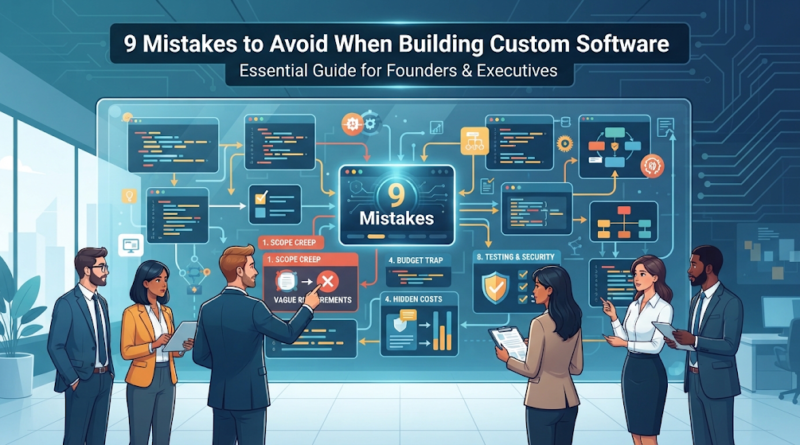
Custom Software Development Mistakes: 9 Pitfalls to Avoid
Custom software development mistakes can completely derail your operations, burn through capital, and leave you with a product that users reject. Whether you are a venture-backed startup launching a disruptive SaaS platform or an established enterprise replacing a clunky legacy system, building tailored digital products comes with steep financial and operational risks.
However, building software from scratch comes with steep financial and operational risks. Without rigorous custom software project planning and clear alignment, projects can easily spiral out of control, burning through capital while delivering a product that users reject.
To protect your investment and maximize your return, here are nine critical mistakes to avoid when undertaking custom software development, along with actionable steps to ensure your project succeeds.
Starting Development Before You Know What to Build
Jumping straight into coding because you are excited about an idea or eager to see visual progress is one of the fastest ways to hemorrhage money. When project requirements are vague, engineering teams spend weeks guessing what you actually need, leading to endless rework, bloated codebases, and architectural instability.
Mistake 1: Launching Without a Validated Product Scope
Many founders and executives treat a rough concept as a complete product blueprint. They skip deep discovery phases, user journey mapping, and wireframing, expecting developers to “figure it out along the way.” This lack of upfront clarity makes accurate budgeting impossible and directly triggers major software development project risks.
-
How to fix it: Invest in a dedicated discovery and scoping phase before writing a single line of production code. Build interactive low-fidelity or high-fidelity prototypes and put them in front of real users or internal stakeholders. Validate your core workflows, test usability assumptions, and lock down a comprehensive product requirements document (PRD) to serve as your single source of truth.
Mistake 2: Failing to Define Clear Business Objectives
Building custom software just because a competitor did or because a technology is trendy will inevitably lead to a solution looking for a problem. If you cannot explicitly state how the software will reduce operational overhead, accelerate user onboarding, or drive measurable revenue, your project lacks strategic direction.
-
How to fix it: Tie every major software capability back to a quantifiable Key Performance Indicator (KPI). Whether you are building an internal business system to cut processing time by 40% or a customer portal to boost retention, establish your success metrics upfront so your engineering team can prioritize features that move the needle.
The Budget Trap: Why Cheap Estimates Become Expensive Projects
Software economics are notoriously counterintuitive. Choosing a development partner solely based on the lowest initial bid often translates into the highest total cost of ownership down the line.
Mistake 3: Selecting Vendors Based Solely on Low Upfront Estimates
It is tempting to award a contract to the agency promising the lowest price and fastest timeline. Unfortunately, low-ball estimates often omit critical phases like security audits, rigorous testing, DevOps setup, and ongoing maintenance. Once you are halfway through development, those “missing” costs suddenly appear as expensive change orders.
-
How to fix it: Request transparent, milestone-based pricing models that break down discovery, design, engineering, QA, and deployment. Look for development partners who challenge your assumptions and provide realistic estimates rather than telling you what you want to hear to win the deal.
Mistake 4: Ignoring Long-Term Maintenance and Scalability Costs
Failing to account for long-term expenses is one of the most common custom software development mistakes that turns an affordable build into a financial drain. Many business leaders budget exclusively for the initial launch, completely forgetting that software is a living asset. Bug fixes, security patches, cloud hosting infrastructure, and minor feature updates require ongoing capital. Neglecting these recurring expenses leads to rapid technical debt and system degradation.
-
How to fix it: Allocate 15% to 20% of your initial development budget annually for ongoing maintenance, infrastructure optimization, and iterative enhancements. Factor operational costs into your financial model from day one to ensure your software remains viable over its entire lifecycle.
Choosing Technology Before Understanding the Business
The tech stack you select dictates your application’s performance, security, speed-to-market, and future flexibility. Yet, decisions are frequently driven by developer preferences or fleeting industry hype rather than business utility.
Mistake 5: Chasing Over-Engineered Tech Stacks
It is easy to fall into the trap of using bleeding-edge frameworks, microservices architectures, or complex distributed databases simply because they are popular on developer forums. If you are building an early-stage MVP or a straightforward internal tool, an overly complex stack will drastically slow down delivery and make it difficult to find engineers who can maintain the code.
-
How to fix it: Choose mature, battle-tested technologies that align with your team’s expertise and your immediate business goals. Prioritize developer productivity, ecosystem support, and ease of deployment. You can always refactor or scale your architecture later once your product has achieved market traction or user scale.
Mistake 6: Neglecting Seamless Integration with Existing Ecosystems
Whether you are replacing an inefficient legacy system or launching a new SaaS product, your custom software must communicate smoothly with your broader tech ecosystem—payment gateways, CRM systems, ERPs, and identity providers. Treating your software as an isolated island creates severe data silos and frustrating manual workarounds for your team.
-
How to fix it: Map out your complete data flow and integration requirements during the early planning stages. Ensure your architecture relies on well-documented REST or GraphQL APIs, secure webhooks, and modular design patterns to guarantee seamless data synchronization across all your business tools.
The Features That Slow Your Product Down
When building custom software, less is frequently more. Trying to build a massive, all-encompassing platform on day one is a primary catalyst for delayed launches and inflated custom software development cost.
Mistake 7: Falling Victim to Scope Creep and Feature Bloat
Founders and stakeholders often want to pack every conceivable idea into the initial release. As new requests pour in from team members or early prospects, the project scope expands uncontrollably. The result? Missed deadlines, exhausted teams, and a cluttered user experience that confuses your target audience.
-
How to fix it: Embrace a disciplined Minimum Viable Product (MVP) or Minimum Marketable Product (MMP) strategy. Use frameworks like the MoSCoW method (Must-haves, Should-haves, Could-haves, Won’t-haves) to ruthlessly prioritize features. Focus entirely on solving the core problem exceptionally well, then layer on secondary features based on real user feedback post-launch.
Shipping Without a Plan for Security, Testing, and Growth
Treating quality assurance and security as an afterthought—something rushed through in the final week before launch—almost always results in public failures, data breaches, and frustrated users abandoning your platform.
Mistake 8: Treating Quality Assurance and Testing as an Afterthought
Relying solely on developers to test their own code or skipping automated testing to save time guarantees that bugs will slip into production. For mission-critical internal systems or customer-facing mobile apps, a single critical crash or data error can destroy user trust overnight.
-
How to fix it: Integrate QA engineers into your project team from the very beginning. Implement a balanced testing strategy that includes automated unit tests, integration tests, and manual exploratory testing. Continuous integration and continuous deployment (CI/CD) pipelines should automatically run tests every time new code is pushed.
Mistake 9: Overlooking Security, Compliance, and Data Privacy
In an era of rising cyber threats and stringent regulations like GDPR, HIPAA, and CCPA, building insecure software is an existential business risk. Failing to encrypt sensitive data, implement robust role-based access controls, or conduct vulnerability scans can lead to catastrophic data breaches, heavy fines, and permanent reputational damage.
-
How to fix it: Bake security into your software development lifecycle (SDLC) from day one, rather than trying to patch vulnerabilities right before launch. Conduct regular code reviews, dependency scans, and third-party penetration testing. Ensure your cloud infrastructure is configured according to industry best practices and compliance standards relevant to your industry.
Build Better Software with Confidence
Avoiding these common pitfalls requires more than good intentions—it demands rigorous execution, technical expertise, and a strategic partnership focused on your long-term business goals. Whether you are launching an innovative SaaS platform, modernizing a legacy enterprise system, or building a high-performance mobile application, having the right engineering partner makes all the difference.
Discuss your software requirements, validate your product idea, or plan your next custom software project with Yorru Softwares today. Let’s build scalable, secure software that drives real business growth.
