
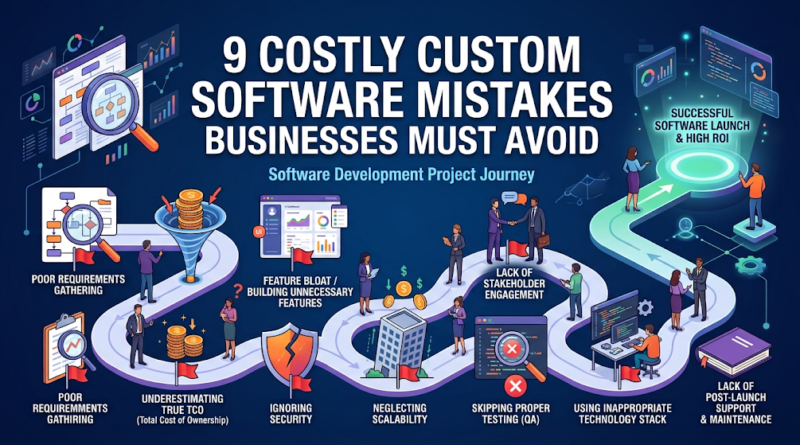
9 Costly Custom Software Mistakes Businesses Must Avoid
Committing costly custom software mistakes can turn a six-figure development budget into a financial sinkhole before the first line of code is even written. Imagine waiting eight months for a highly anticipated launch, only to realize your team refuses to use the new system because it takes twice as long as their old spreadsheets.
It happens more often than you might think. Building custom software for businesses is a high-stakes investment. When executed correctly, bespoke applications eliminate operational bottlenecks, create new revenue streams, and provide a lasting competitive advantage. When mismanaged, they become financial liabilities that drain resources and frustrate stakeholders.
Almost every software failure can be traced back to decisions made during the initial planning phases. To protect your budget and ensure a high ROI, here are the nine most common pitfalls organizations face—and how to avoid them.
Choosing Custom Software Before Defining the Real Business Problem
The most dangerous phrase in product development is, “We need an app for that.” Jumping straight into solutions without diagnosing the underlying operational friction guarantees you will build the wrong product.
1. Mistaking a Symptom for the Core Problem A business might decide it needs a custom inventory management system because stockouts are frequent. However, a deeper discovery process might reveal that the real issue isn’t inventory tracking, but poor communication between the procurement and sales departments. If you build software to solve a symptom, the core problem remains. Before commissioning a build, define exact, measurable objectives: We need to reduce inventory holding costs by 15% and automate procurement approvals.
2. Automating Broken Business Processes Custom software is not a magic wand for bad workflows. If your current manual processes are convoluted, redundant, or undocumented, digitizing them will only give you a faster broken process. Before engaging developers, conduct thorough process mapping. Document how data flows through your organization today, identify the bottlenecks, and redesign the workflow for efficiency. Only then should you build software to support that new workflow.
Underestimating the True Cost of Custom Software Development
A primary reason executives experience sticker shock during a project is a fundamental misunderstanding of how software pricing works. The initial development estimate is just one component of the overall financial picture.
3. Confusing the Initial Quote with Total Cost of Ownership (TCO) The price to write the code is not the total custom software development cost. Businesses routinely forget to budget for the surrounding ecosystem of a software product. A realistic TCO framework must account for:
-
Discovery and planning: Requirements gathering and process mapping.
-
UI/UX design: Prototyping and user testing.
-
Infrastructure: Cloud hosting (AWS, Azure, Google Cloud) and database costs.
-
Third-party integrations: API licensing fees for payment gateways, CRMs, or ERPs.
-
Maintenance: Bug fixes, OS updates, and security patches.
A good rule of thumb is to budget 15% to 20% of the initial development cost for annual post-launch maintenance.
4. Choosing a Custom Software Development Company Based Only on Price Accepting the lowest bid is often the most expensive mistake a business can make. A vendor offering a quote at half the market rate is likely cutting corners on quality assurance, skipping architecture planning, or planning to hit you with excessive change orders for every minor adjustment. Choosing a custom software development company should be based on their technical expertise, communication cadence, and track record of solving business problems—not just their hourly rate.
Building Features Nobody Actually Needs
More features do not equal a better product. In fact, feature bloat is a leading cause of delayed launches and budget overruns.
5. Skipping the Minimum Viable Product (MVP) When stakeholders brainstorm software requirements, the “nice-to-have” list quickly outgrows the “must-have” list. The MVP approach prevents this. An MVP forces you to identify the core functionality required to solve your primary business problem and launch it to users quickly. For example, if you are building an internal CRM for a field sales team, the executives might want advanced predictive analytics. But if you talk to the sales reps, their primary pain point is simply logging meeting notes from their phones. By launching the mobile logging feature first (the MVP), you deliver immediate value, secure user adoption, and test the system before spending money on complex analytics.
6. Allowing Unchecked Scope Creep Scope creep occurs when new requirements are continuously added to the project after development has begun. Without strict software development project management, a simple portal can morph into a massive enterprise platform. To avoid this, establish a rigid feature prioritization framework. When a new idea is proposed mid-project, document it in a “Phase 2” backlog rather than disrupting the current development sprint.
Ignoring Scalability, Security, and Long-Term Maintenance
Software is a living asset. If you design it strictly for the constraints of today, it will break under the pressure of tomorrow.
7. Treating Security as a Pre-Launch Add-On Security cannot be bolted onto an application right before deployment. It must be woven into the architecture from day one. Failing to prioritize data security, authentication, authorization, and secure API endpoints leaves your business vulnerable to data breaches. Remediating a vulnerable application post-launch is significantly more expensive than building it securely from the start.
8. Designing Only for Your Current User Base An application built to handle 50 internal employees might collapse when rolled out to 5,000 external clients. Ignoring scalability leads to heavy technical debt. Your development team must plan for future infrastructure needs, load balancing, and database architecture that can scale vertically and horizontally as your data storage and concurrent user limits grow.
9. Viewing Launch Day as the Finish Line Launch day is the starting line. Browsers update, APIs deprecate, and security standards evolve. If you fail to plan for continuous software updates, your custom application will become a legacy system in a matter of years. Establish a long-term maintenance agreement to ensure your software remains secure, compliant, and compatible with the broader technology ecosystem.
What Successful Custom Software Projects Do Differently
While failed projects are chaotic and reactive, successful software implementation follows predictable habits. Companies that consistently generate high ROI from custom builds share a specific set of practices:
-
Deep User Involvement: They don’t just ask executives what the software should do; they interview the frontline employees who will use it daily.
-
Agile Iteration: They build in short sprints, review the working software frequently, and adjust course based on tangible progress rather than theoretical documentation.
-
Continuous Testing: Quality assurance (QA) isn’t saved for the end. Code is tested continuously to catch and resolve bugs when they are cheapest to fix.
-
Defined Success Metrics: They establish exactly how success will be measured post-launch, whether that is a 20% reduction in manual data entry, faster customer onboarding, or reduced server costs.
-
Strong Vendor Collaboration: They treat their development agency as a strategic partner, maintaining transparent, weekly communication rather than treating them like a hands-off vendor.
Is Custom Software Development Worth the Cost?
Because bespoke software requires a significant upfront investment of capital and time, business leaders naturally question the financial viability. The truth is, custom software is not the right choice for every situation.
If your business needs a tool for standard, commoditized functions—like basic bookkeeping, payroll, or email hosting—an off-the-shelf SaaS product is almost always the better choice. There is no reason to reinvent the wheel when mature, low-cost alternatives exist.
However, custom software development is absolutely worth the cost when:
-
You have unique business processes: Off-the-shelf software forces you to adapt your workflows to fit the tool. Custom software adapts to fit your optimized workflows.
-
You need a competitive advantage: If you are using the exact same customer-facing software as your competitors, you cannot offer a superior digital experience.
-
You require complex integrations: When your business relies on multiple disparate systems (legacy ERPs, specialized manufacturing hardware, etc.) that refuse to communicate, a custom middleware solution can unify your data.
-
You want to own your data and IP: Licensing fees for SaaS platforms escalate dramatically as your user count grows. With custom software, you own the intellectual property, meaning your platform scales without proportionate increases in per-user licensing costs.
When deployed strategically, the total cost of ownership for custom software often drops below that of expensive, enterprise-tier SaaS subscriptions over a 3-to-5-year horizon, delivering a massive long-term ROI.
People Also Ask
What are the biggest mistakes to avoid when developing custom software?
The most damaging custom software mistakes include failing to define clear business requirements before development, skipping user research, underestimating long-term maintenance costs, allowing unchecked scope creep, and choosing a vendor solely based on the cheapest initial estimate. Avoiding these pitfalls requires rigorous upfront planning and strict project management.
How can businesses reduce the cost of custom software development?
To control the development budget, start by building a Minimum Viable Product (MVP) that includes only the features absolutely necessary to solve your core business problem. Additionally, you can reduce costs by thoroughly mapping out your business processes before hiring developers, using third-party APIs for non-core functions (like payment processing) instead of building them from scratch, and prioritizing ongoing QA testing to catch bugs early.
Conclusion
High-performing custom software is rarely the result of a single brilliant technical breakthrough. It is the result of disciplined business strategy, clear requirements, realistic budgeting, and a refusal to build unnecessary features. Avoiding these costly custom software development mistakes ensures your project stays on schedule, respects your budget, and actually solves the problem you set out to fix.
If you are tired of working around the limitations of off-the-shelf software or need to replace a legacy system that is slowing your business down, it is time to consult with a team that understands both code and commerce. Contact our software development experts today to discuss your operational challenges, map out your requirements, and get a realistic roadmap for your next custom software project.
