7 Reasons SaaS MVPs Fail Before They Launch
A founder spends nine months and $85,000 building a beautifully engineered SaaS application. The architecture is scalable, the code is clean, and the database is optimized. Launch day arrives, the marketing emails go out, and the result is deafening silence. Nobody signs up. Nobody cares.
This is not a rare nightmare; it is a statistical reality. Founders frequently pour immense amounts of time, capital, and emotional energy into software products that the market simply does not want.
If you want to know how to build a SaaS MVP (Minimum Viable Product) that actually succeeds, you first have to understand why so many fail before they even cross the starting line.
The MVP Mistakes That Kill SaaS Products Before Day One
People often ask: Why do most SaaS MVPs fail?
The hard truth is that they rarely fail because the engineering team could not write good code. They fail because of critical decisions made months before the first line of code was ever written.
SaaS MVP development is not just a technical challenge; it is fundamentally a business strategy challenge. A successful MVP proves that you have found a real problem, that your target audience cares enough to solve it, and that your solution is something they will pay for. When founders prioritize development over discovery, they build robust solutions for phantom problems.
Understanding common SaaS MVP mistakes is the only way to safeguard your budget and ensure you are building a product with actual market viability.
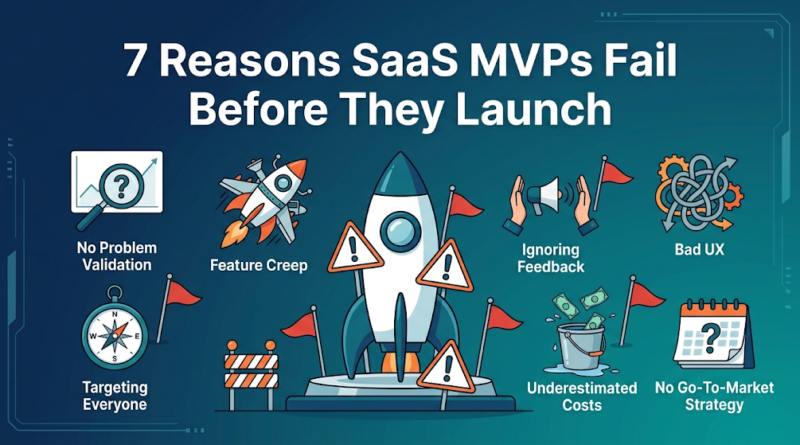
7 Reasons Your SaaS MVP Never Makes It to Market
The road to a failed launch is usually paved with good intentions and dangerous assumptions. Here are the seven most common reasons why SaaS startups fail during the MVP stage.
1. Building a Solution Before Validating the Problem
-
Why it happens: Founders often experience a mild inconvenience, invent a complex software solution for it, and assume millions of other people share their exact pain point.
-
Why it creates risk: You end up building a product nobody is actively searching for, resulting in zero product-market fit.
-
Realistic scenario: A founder builds an AI-powered, fully automated scheduling tool for local plumbers. After launch, they discover that plumbers are perfectly happy using a whiteboard and a cheap calendar app. The “problem” was not severe enough to warrant a paid software solution.
-
What to do instead: Validate the severity of the problem first. Talk to potential users and ask how they currently solve the issue. If they aren’t already spending time or money trying to fix it, your SaaS tool won’t change their behavior.
2. Trying to Include Too Many Features
-
Why it happens: In an effort to impress early adopters or compete with legacy enterprise software, founders try to build the “ultimate” all-in-one tool.
-
Why it creates risk: Feature bloat delays your launch, burns through your capital, and dilutes the core value proposition of your product.
-
Realistic scenario: A startup building a simple time-tracking app for freelancers decides they also need to add invoicing, a CRM, and a project management dashboard for version 1.0. Development takes a year instead of three months.
-
What to do instead: Identify the single core action your user needs to take. Build only the features required to facilitate that one action.
3. Targeting Everyone Instead of a Specific Customer
-
Why it happens: Founders fear missing out on potential revenue, so they define their audience broadly (e.g., “small businesses” or “anyone with a smartphone”).
-
Why it creates risk: When you design a product for everyone, it solves nobody’s problem perfectly. Your marketing messaging becomes diluted, and user acquisition costs skyrocket.
-
Realistic scenario: A marketing analytics SaaS positions itself for “all digital marketers.” It loses enterprise clients to complex enterprise tools, and loses solo creators to simpler, cheaper tools.
-
What to do instead: Pick a hyper-specific niche for your MVP. Dominate a narrow market segment (e.g., “marketing analytics for independent Shopify jewelry brands”) before expanding.
4. Ignoring Real User Feedback
-
Why it happens: Confirmation bias. Founders fall in love with their original vision and subconsciously reject feedback that contradicts it.
-
Why it creates risk: You build the product you want, not the product the market needs.
-
Realistic scenario: Beta testers repeatedly tell a founder that the dashboard is confusing. The founder assumes the users just “aren’t tech-savvy enough” and pushes forward with the launch without fixing the UI. User retention flatlines.
-
What to do instead: Treat user feedback as objective data. If multiple users stumble on the same feature, the feature is broken, not the user.
5. Underestimating UX and Usability
-
Why it happens: Founders confuse “Minimum Viable” with “ugly, buggy, and hard to use.”
-
Why it creates risk: Modern users have high expectations. If your SaaS product is frustrating to navigate, users will abandon it within minutes, even if the underlying technology is brilliant.
-
Realistic scenario: A B2B data extraction tool requires users to read a 10-page manual just to set up their first query. Users churn during the free trial.
-
What to do instead: Keep the feature set minimal, but make sure the user experience (UX) for those few features is seamless, intuitive, and visually trustworthy.
6. Treating Development Cost and Timeline as Afterthoughts
-
Why it happens: Founders begin coding without a strict scope of work, assuming they can just “figure it out as they go.”
-
Why it creates risk: Scope creep leads to unpredictable SaaS MVP development cost and blown deadlines, causing startups to run out of money before they can even launch.
-
Realistic scenario: A founding team budgets $40,000 for an MVP. Because they keep adding “just one more feature” during development, the bill hits $75,000, leaving zero budget for marketing.
-
What to do instead: Lock in your MVP scope before development starts. Treat any new feature idea as an addition for Version 2.0.
7. Launching Without a Measurable Go-to-Market Strategy
-
Why it happens: The “if you build it, they will come” fallacy. Founders assume a great product will organically sell itself.
-
Why it creates risk: Even the most revolutionary SaaS product will fail if nobody knows it exists.
-
Realistic scenario: A team spends six months building a product. On launch day, they post a single link on LinkedIn and Product Hunt. They get a tiny spike in traffic, zero conversions, and have no plan for what to do on day two.
-
What to do instead: Build your distribution channels alongside your product. Start an email list, build industry relationships, and plan your customer acquisition strategy months before the software is finished.
Building Too Much Is Often the First Red Flag
When planning SaaS product development, the most dangerous phrase a founder can utter is, “It would be cool if…”
An MVP is not a stripped-down, low-quality version of your final product. It is the smallest possible iteration of your product that delivers genuine value to a user. When you build too much, you accumulate technical debt and inflate your SaaS MVP development cost unnecessarily. More importantly, excessive scope delays your ability to learn from real, paying customers.
To prevent overbuilding, ruthlessly prioritize your roadmap using a framework like MoSCoW:
-
Must-Have: Features the product literally cannot function without (e.g., user authentication, the core problem-solving algorithm).
-
Should-Have: Important features that add significant value but are not strictly necessary for day one (e.g., password reset via SMS).
-
Could-Have: Nice-to-have features if time and budget permit (e.g., dark mode).
-
Won’t-Have: Features explicitly excluded from the MVP.
If a feature doesn’t directly solve the user’s primary pain point, move it to the “Won’t-Have” list for now.
How to Validate Your SaaS Idea Before Writing More Code
People frequently ask: How do you validate a SaaS MVP before development?
SaaS MVP validation is the process of proving people will use and pay for your product before you invest heavily in engineering. Real validation requires you to look past vanity metrics—like social media likes, encouraging comments from friends, or a spike in website traffic—and seek actual behavioral commitments.
Here are proven ways to validate your concept:
-
Customer Interviews: Talk to your target audience. Ask them how they currently solve the problem and how much that current solution costs them in time or money.
-
Landing Pages and Waitlists: Build a high-converting landing page explaining your product’s value proposition. Drive targeted ads to it. If people won’t give you their email address for early access, they likely won’t pay for the software.
-
Concierge MVPs: Deliver the SaaS value manually before automating it. If you are building an automated financial reporting tool, ask users to send you their raw data and manually build the reports in Excel to see if they find the output valuable.
-
Clickable Prototypes: Use design tools to create a realistic mockup of your software. Put it in front of users for usability testing. Watch where they click and ask for their honest feedback on the workflow.
-
Letters of Intent (LOI) or Pre-sales: In B2B SaaS, the ultimate validation is a signed LOI or a discounted pre-payment from a business committing to use the software once it is built.
From MVP to Market: A Smarter Path to Launch
Taking a SaaS product from an idea in your head to a live application requires a disciplined, step-by-step approach. Jumping ahead in the sequence is how costly mistakes are made.
Follow this practical roadmap:
Problem → Customer → Validation → MVP Scope → Prototype → Development → Testing → Early Users → Feedback → Iteration
As you move from scoping to development, it often makes sense to bring in experienced technical help. You do not have to build an in-house engineering team from day one. Partnering with a software development company allows you to leverage experienced product managers, UX/UI designers, and senior engineers without the overhead of full-time hires.
When approaching a development partner, be prepared. Bring your validated problem, your specific target audience, your clickable prototype (or wireframes), and a strictly prioritized feature list.
Keep in mind that there is no universal price tag for software. SaaS MVP development cost is heavily influenced by factors such as:
-
The complexity of the core features and algorithms.
-
The necessity of third-party API integrations (e.g., payment gateways, CRMs).
-
Data security and compliance requirements (like HIPAA or SOC2).
-
The inclusion of complex AI or machine learning capabilities.
-
The geographic location and expertise of your development team.
By controlling your scope and validating your idea early, you ensure that every dollar spent on development is an investment in a product the market actually wants.
Ready to Build a SaaS Product Users Actually Want?
You have validated your market, identified a pressing problem, and mapped out a tight MVP scope. Now it is time to build it right.
Partnering with an experienced software development team ensures your MVP is built with scalable architecture, intuitive UX, and clean code—without the delays of scope creep. If you are ready to turn your validated SaaS idea into a market-ready reality, reach out to discuss your product strategy, technical requirements, and how we can help you build a profitable MVP.
