
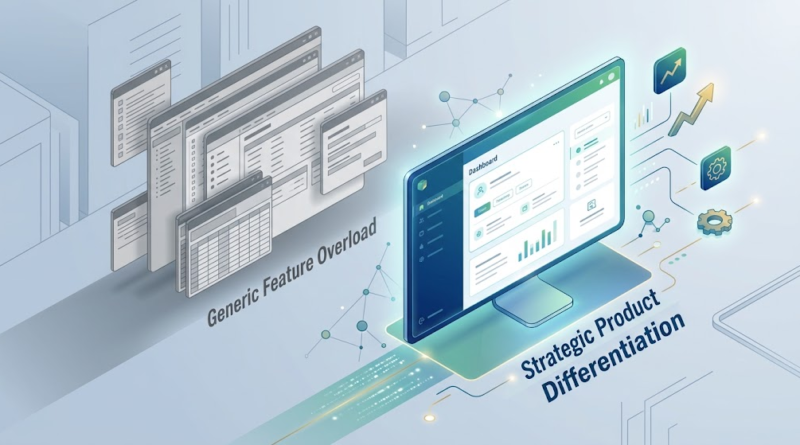
Software Product Differentiation: Why Great Products Stand Out
Effective software product differentiation has become the ultimate hurdle for modern engineering teams. A modern engineering team can take a concept, assemble pre-built authentication services, hook up cloud infrastructure, leverage AI coding assistants, and deploy a functioning Web application in a single weekend. Yet, those same fast-moving teams routinely launch products that struggle to secure a single paying customer. The paradox of modern tech development is striking: while building functional software has never been easier, convincing people to choose, pay for, and stick with your software has never been harder.
As technical barriers drop, the market is flooded with applications that check every functional box on paper but fail to generate real traction. When basic capability becomes a commodity, competitive advantage shifts. Standing out no longer depends on whether your team can write code to solve a problem—it depends on whether you have selected the right problem, understood the human context around it, and executed a solution that creates lasting business value.
When Building Software Gets Easier, Standing Out Gets Harder
The mechanics of software creation have undergone a massive shift. Open-source frameworks, low-code utilities, serverless architecture, and AI-driven development tools have dramatically accelerated delivery schedules. Tasks that once required months of custom architecture—such as payment gateway integration, database provisioning, and user management—can now be configured in hours.
This democratization of software development brings undeniable advantages, but it fundamentally changes market dynamics:
-
Lower Barriers to Entry: Marketplaces are increasingly saturated with products that tackle identical use cases.
-
Feature Parity as a Baseline: Competitors can clone exposed features rapidly, turning visual functionality into a temporary advantage.
-
Shift in Value Creation: Because code generation is accessible, the market value shifts away from pure execution speed toward strategic direction, product architecture, and domain alignment.
Navigating this reality does not mean custom engineering or deep technical expertise lost its value. Rather, it means that writing code is no longer the sole source of differentiation. A functional application merely grants entry to the market; long-term commercial success requires intentional software product differentiation.
When any team can build an application that works, the winning products are those designed around deep user context, superior reliability, and real-world workflows.
Beyond Features: The Difference Between Functional and Valuable Software
It is tempting to measure progress by feature velocity. Product roadmaps quickly fill up with competitor parity requests, integration checklists, and customer wishlists. However, expanding a feature set without a cohesive strategy rarely leads to market leadership—it often leads to bloated software that confuses users and increases maintenance costs.
Functional vs. Valuable: A Practical Comparison
Consider two enterprise expense-tracking platforms serving mid-market companies:
-
Product A (Feature-Dense): Offers 40 distinct features, including custom multi-currency conversions, complex approval hierarchies, automated receipt scanning, and custom reporting widgets. However, the navigation is dense, setting up custom rules requires reading extensive documentation, and submitting an expense report takes nine distinct clicks across three screens.
-
Product B (Outcome-Focused): Offers only 10 features, focusing strictly on corporate card synchronization, one-touch mobile receipt capture, and automated policy checking. The product integrates directly into the company’s primary chat platform, allowing employees to approve expenses in two seconds without logging into a separate dashboard.
While Product A looks superior on a sales comparison matrix, Product B captures market share, achieves higher daily active usage, and boasts superior renewal rates. Product B succeeds because it respects user attention and minimizes friction.
+-----------------------------------------------------------------------+
|                       FEATURE-DENSE vs. OUTCOME-FOCUSED               |
+-----------------------------------------------------------------------+
| Feature-Dense (Product A)             Outcome-Focused (Product B)     |
| -------------------------             ---------------------------     |
| • 40+ granular features               • 10 core targeted features     |
| • High administrative overhead        • Automated policy checks       |
| • Complex 9-step submission flow      • 2-second inline approvals     |
| • Frequent support tickets            • High adoption & retention     |
+-----------------------------------------------------------------------+
Driving Real Business Value
Effective software product strategy focuses on business outcomes rather than output volume. Building valuable software requires a deliberate approach:
-
Solving Defined Problems: Address explicit pain points rather than vague inconveniences.
-
Mapping Real Workflows: Accommodate how teams actually work rather than forcing them into artificial software structures.
-
Reducing Cognitive Load: Cut unnecessary steps, hide rarely used settings, and clarify primary actions.
-
Prioritizing Business Impact: Evaluate new features based on whether they save time, cut operational expense, or generate revenue for the end user.
User Experience Is No Longer a Nice-to-Have
User experience is frequently misconstrued as visual polish—a layer of clean typography, modern color palettes, and slick micro-animations added near the end of a project. In practice, true user experience is structural. It determines how intuitive, reliable, and efficient a system feels during daily operation.
When software feels confusing, slow, or predictable only to its creators, users abandon it—regardless of how powerful the underlying technology may be.
UX as a Engine for Operational Efficiency
To understand how software user experience and usability directly impact business metrics, consider an internal inventory management tool used by a distribution center:
Scenario: A logistics firm uses custom software to log incoming warehouse shipments. The original system required workers to select a vendor from a dropdown of 2,000 entries, manually input stock-keeping units (SKUs), and confirm location codes across three separate tabs. Processing a single pallet took 4.5 minutes.
Redesign: By redesigning the interface to support barcode scanning, auto-populating vendor details based on expected arrival schedules, and unifying the workflow into a single context-aware screen, processing time dropped to 45 seconds per pallet.
In this case, improving UX was not about aesthetics; it directly expanded warehouse capacity, reduced input errors, and cut training times for new hires.
Key Factors of High-Impact User Experience
-
Onboarding Efficiency: Shorten time-to-value so users experience the main benefit of the product immediately.
-
System Performance: Maintain responsive loading times; speed is a fundamental UX feature.
-
Consistency: Use predictable interaction patterns across screens to minimize user learning curves.
-
Error Resilience: Prevent mistakes through smart defaults and provide clear, actionable recovery paths when errors occur.
The Competitive Edge: Business Context, Integration, and Execution
To build a product that commands customer loyalty, product leaders must look beyond basic UI and raw code. Lasting advantage lives in areas that are difficult to replicate quickly: deep industry domain knowledge, system integration, technical architecture, and execution discipline.
Alignment with Business Reality
The most effective software fits seamlessly into an organization’s existing ecosystem. A custom CRM platform, for instance, achieves maximum impact when it connects directly with existing ERP databases, financial systems, customer support queues, and communication tools. Bridging these disconnected processes eliminates manual data entry and unifies organizational visibility.
                      +-------------------------+
                      |   Core Custom System    |
                      +------------+------------+
                                   |
         +-------------------------+-------------------------+
         |                         |                         |
+--------v--------+       +--------v--------+       +--------v--------+
|   Legacy ERP    |       | Support Queues  |       | Finance Platform|
|   Databases     |       |   & Ticketing   |       |   & Invoicing   |
+-----------------+       +-----------------+       +-----------------+
Strategic Elements of Sustainable Differentiation
-
Deep Domain Integration: Understanding specific industry constraints, regulatory requirements, and operational nuances better than generic market alternatives.
-
Architectural Integrity: Making sound decisions around security, data privacy, system scalability, and maintainability that protect customer operations over time.
-
Purposeful AI and Automation: Applying machine learning and automation to solve specific bottle-necks—such as predictive routing or automated document extraction—rather than adding generic chat widgets for novelty.
-
Rapid Feedback Execution: Establishing disciplined iteration cycles that translate user behavior and feedback into product refinements quickly.
When evaluating building competitive software products, the mastery of business context and technical execution consistently outweighs sheer development velocity.
How to Build Software Customers Choose, Trust, and Keep Using
Creating software that drives business growth requires a structured development lifecycle. Modern teams build successful solutions by combining rigorous customer discovery with disciplined engineering.
  1. Identify High-Value Problem
                 │
                 ▼
  2. Validate with Real Users
                 │
                 ▼
  3. Design Core Useful Experience
                 │
                 ▼
  4. Build for Growth & Security
                 │
                 ▼
  5. Measure Outcomes & Iterate
1. Identify a High-Value Customer Problem
-
Meaning: Focus on acute, persistent business challenges rather than minor inconveniences.
-
Importance: Building software for a weak pain point results in low user adoption and continuous sales resistance.
-
Actionable Step: Interview prospective users to identify tasks that consume excessive time, incur high financial costs, or cause operational delays.
2. Validate the Problem Before Overbuilding
-
Meaning: Test your underlying assumptions with real market target groups before committing significant engineering resources.
-
Importance: Early validation prevents investing capital into features or products that the market does not actually want.
-
Actionable Step: Run structured interviews, build clickable prototypes, or test lightweight mockups to observe how potential users respond to proposed solutions.
3. Design the Simplest Useful Experience
-
Meaning: Focus design effort on solving the main core task as simply and directly as possible.
-
Importance: Clutter and early feature sprawl dilute the core value proposition of your product.
-
Actionable Step: Map out the absolute minimum user journey required to complete the core task, eliminating extraneous steps or settings.
4. Build for Integration, Security, and Reliability
-
Meaning: Construct software on scalable, secure architectures that easily connect with existing business software ecosystems.
-
Importance: Flaws in security, uptime, or performance quickly destroy user trust, regardless of user interface quality.
-
Actionable Step: Establish robust API architectures, maintain strict data access security standards, and prioritize automated testing early in development.
5. Measure Outcomes and Improve Continuously
-
Meaning: Track how users interact with the system post-launch and iterate based on actual operational data.
-
Importance: Sustained software product development success depends on continuous refinement and adaptability to evolving customer needs.
-
Actionable Step: Implement privacy-compliant product analytics to identify workflow drop-off points and prioritize roadmap items that resolve observed friction.
Turning Software Strategy into Real-World Advantage
While modern development frameworks have simplified the mechanics of writing code, creating a software product that captures market share and delivers sustained business value of software development remains a disciplined discipline. Lasting advantage is built on deep problem understanding, intentional design, and expert technical execution.
Whether you are launching a new digital platform, refining a core SaaS product, or modernizing enterprise applications, success requires aligning technical decisions with strategic business goals.
If you are evaluating your next software initiative and want to build a solution engineered for impact, security, and long-term performance, reach out to our strategy and engineering team to explore your goals.
